Home > Critical notes > From Quisquiza (16 of 20)
From Quisquiza (16 of 20)
Field Site
Writing at the Edge of the Forest
This note is part of a series written from Quisquiza, in the high-Andean cloud forest of Colombia, where ecological restoration and research now unfold side by side. It reflects on how living and working within this terrain gradually reshapes the way I think about memory, information, and the infrastructures built to sustain them. Check all the notes in this section's index.
I have come to the conclusion that my workplace is a bit unusual.
Not because I live in Quisquiza, in the high Andes of Colombia, surrounded by cloud forest, fog, rain, birds, insects, and an extraordinary number of organisms whose names I still don't know.
But because I am increasingly unable to determine where my workplace actually begins and ends.
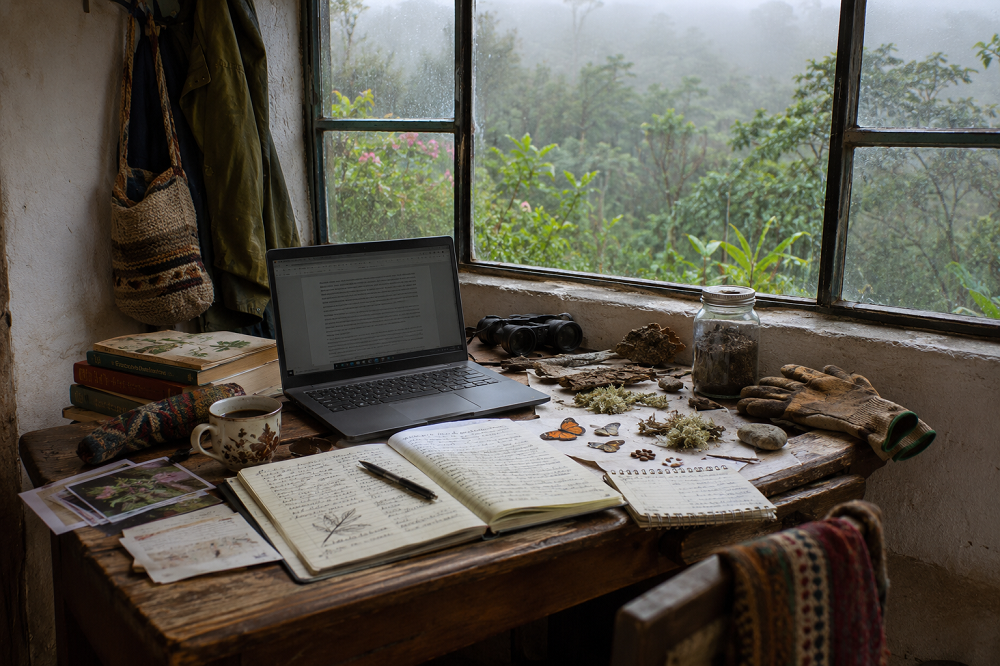
My desk is inside the house, of course. That much is clear. It has a computer, books, notebooks, papers, and a rather alarming accumulation of things that have no business being on a desk. Seeds. Dried lichens. Pieces of bark. Butterfly wings. A few stones. Soil samples. An insect or two, sometimes alive and generally uninvited.
(And coffee. Always coffee. This is Colombia, and that particular component of the research infrastructure is non-negotiable.)
Outside the window, the forest begins. Or perhaps it doesn't begin there at all. Perhaps it continues through the window, across the desk, into the notebooks, and eventually into whatever I happen to be writing.
I have stopped trying to establish the boundary.
Most mornings, I divide my time between activities that, according to the usual professional classifications, should have very little to do with one another. I work on ecological restoration, observe organisms, take photographs, record sounds, read academic literature, develop classification models, and write about knowledge and memory.
Then something breaks, or a trench fills with water, or an animal appears where I wasn't expecting it, and my carefully organized schedule goes straight to hell.
(An occupational hazard, apparently.)
But something interesting has been happening.
A morning spent trying to understand why water refuses to follow the drainage channel I dug changes how I think about information flows. Working with compacted soil makes certain discussions about institutional change considerably less abstract. Observing the extraordinary complexity of a lichen raises uncomfortable questions about the categories we use to describe the world. And recording the sounds of the forest has made me reconsider what we actually mean when we describe an archive as silent.
None of these observations provides a ready-made theory. I am not suggesting that a mountain can solve the problems of librarianship, or that mosses have developed a particularly sophisticated approach to institutional governance.
(Although, having worked in a few "big institutions"... I wouldn't dismiss the possibility entirely.)
What changes is the position from which the questions are asked.
In conventional research, a field site is generally understood as a place where observations are made, information is collected, and evidence is produced. The researcher goes there, documents what happens, and eventually returns to a desk somewhere else to interpret the results.
Here, the desk is already in the field. And the person sitting at it is part of the system being observed. An ignorant, bewildered, frequently mistaken, and sometimes extremely lost part.
That last detail matters. Living in a place does not automatically confer understanding of it. I still misidentify organisms. I make mistakes when planting. I misunderstand the movement of water, underestimate the weather, and discover, occasionally at considerable personal expense, that my explanations were entirely wrong.
My campesino neighbors know things about this territory that I do not. The organisms inhabiting it respond to conditions I can barely detect. Processes unfold over timescales that make my observations almost laughably brief.
Proximity is not expertise. Experience is not automatically evidence. And familiarity is certainly not the same as knowledge.
But proximity does something else. It makes it harder to ignore the consequences of being wrong. A classification mistake in a document can be corrected. An ill-conceived intervention on a slope may leave a scar that takes years to disappear. A theoretical model can overlook a variable without immediate consequences. A drainage channel, however, cannot afford that luxury when the rain arrives.
The distinction is not absolute, of course. Information systems have material consequences too, sometimes devastating ones. But here those consequences are constantly, insistently visible.
The environment interrupts. It contradicts. It delays. It introduces variables that were not invited to participate in the research. And, occasionally, it cooperates.
(Errr... Briefly.)
Working from Quisquiza has not made intellectual work easier. Nor has it transformed rural life into some idyllic alternative to the city. There is mud, exhaustion, uncertainty, broken equipment, cold mornings, and an apparently inexhaustible supply of things requiring immediate attention.
But it has made one assumption increasingly difficult to maintain: that knowledge can be produced independently of the conditions under which it is produced.
Those conditions are not merely contextual information to be mentioned in an introduction and then conveniently forgotten. They influence what can be observed, which questions become important, what kinds of evidence are available, and how much uncertainty one is prepared to tolerate.
They influence the researcher, too. I began working here with certain questions about knowledge, classification, memory, and institutions. I still have them. But the questions themselves are changing, and, honestly speaking, not always in directions I anticipated.
That, I suspect, is part of what makes a place a field site. Not simply that it provides material for research, but that it can change the researcher and the very questions being investigated.
Outside, the fog is moving through the trees again, as usual. There is work to finish on the computer, and a patch of soil I promised myself I would inspect before the next rain.
Both are part of today's research.
Quisquiza is not a retreat from intellectual work. It is where that work now happens. And the forest, unfortunately for my carefully constructed theories, does not seem particularly interested in agreeing with me.