Home > Critical notes > From Quisquiza (14 of 20)
From Quisquiza (14 of 20)
Wind
What the Air Bends
Wind up here in Quisquiza is rarely spectacular.
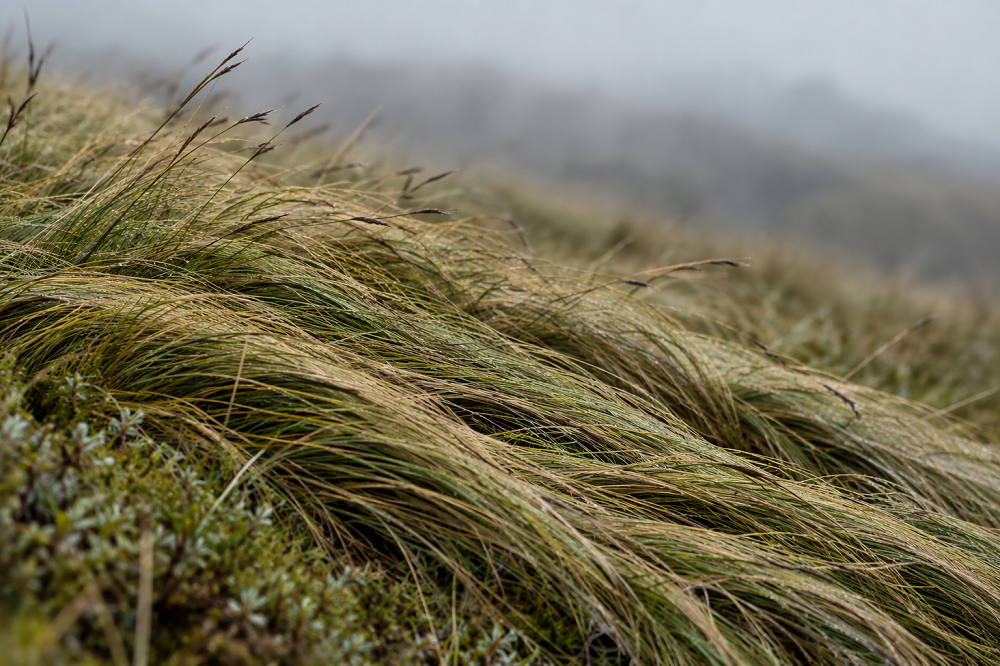
It does not normally arrive as an event, the kind of thing that sends branches (or roofs) flying and gives everyone something to talk about the following morning. Most of the time it is simply there, coming mainly across the mountains from the east, sometimes from the south, moving through the pasture and the forest edges with enough persistence that whole patches of grass can spend days leaning in approximately the same direction.
(I would love to say that it also messes up my hair. Unfortunately, there is increasingly little available material for it to work with.)
The effect is easier to see in young trees. Some grow with a slight inclination; others develop irregular crowns, particularly when they are exposed on one side and protected on another. During stronger gusts their trunks bend, branches move back and forth, leaves turn and flutter, while the roots and lower stem take the strain produced above. When the air becomes still, all that movement disappears. What remains is a plant whose growth has taken place under those conditions.
Plants do, in fact, respond to repeated mechanical stress. Wind is not merely something they withstand while continuing to grow according to an independent plan. Recurrent bending and movement affect growth itself: stems may become shorter and thicker, wood develops in response to loading, and the relationship between crown, trunk and roots changes as the plant adjusts to the forces acting on it. Botanists have given part of this response the formidable name "thigmomorphogenesis," which basically describes the ways plant growth changes in response to mechanical stimulation.
The results are particularly obvious where wind is persistent and directional. Trees exposed for years may develop forms that differ markedly from individuals of the same species growing a few meters away in shelter. Their architecture is therefore partly a record of conditions that may not be present when somebody finally stops to look at them. On a calm morning, there is no visible gust to explain the angle of a trunk or the uneven development of a crown. One has to reconstruct some of the history from the form itself.
That interests me because we tend to think about influence through events. Something intervenes, produces an effect, and leaves a trace that allows us to connect the two. But plenty of forces operate less dramatically. They act through repetition, through small differences maintained over time, and eventually become difficult to separate from the structure that developed under them.
Research certainly works that way.
A field of research does not grow only from the questions that researchers independently decide are important. It also develops within funding systems, university priorities, governmental programs, publication practices, available technologies, professional incentives and whatever happens to be intellectually fashionable at a particular moment. None of these necessarily determines what an individual scholar will do. Researchers routinely ignore incentives, pursue unfashionable problems, work without funding and invent routes around institutional obstacles. But over years and decades, the distribution of resources and opportunities inevitably makes some trajectories easier to follow than others.
Funding is an obvious example. A call for proposals does not need to prohibit a particular subject in order to influence a field. It can simply make several other subjects considerably easier to investigate. Laboratories are equipped, studentships are created, datasets are produced, conferences appear... Researchers trained within those projects later design projects of their own. After enough cycles, an area that initially benefited from a funding priority may possess the people, vocabulary, infrastructure and accumulated evidence required to attract still more work.
The original gust has long since passed, but the research landscape is no longer the same.
Libraries and archives develop under comparable pressures. Acquisition budgets, institutional mandates, cataloguing standards, donor interests, preservation priorities, staffing, legislation and relationships with particular communities all affect what enters a collection and what does not. Some materials arrive accompanied by money, expertise and established descriptive practices. Others require labor the institution has never funded, languages nobody on staff reads, relationships that take years to establish, or forms of description that existing systems handle badly.
Eventually the collection itself begins to look like an objective representation of what exists or what mattered. It is easy to forget that it also has a history of exposure.
The same problem appears in classification. Categories that have been used and maintained for decades become dense with definitions, cross-references, authority records and technical infrastructure. Things that entered later, or were never considered when the system was built, may remain awkwardly attached at the edges. Their marginal position can then appear to be a property of the things themselves rather than a consequence of the history of the structure describing them.
None of this means that institutional influence works like a prevailing wind in any simple or deterministic sense. Human beings argue, refuse, redirect resources, create alternative institutions, change vocabularies and sometimes dismantle the structures they inherited. Nor does every irregularity in a collection or discipline point back to a single external pressure. There are too many forces involved for that: history, accident, personalities, technologies, conflicts, opportunities, absences, decisions whose consequences nobody foresaw.
But that complexity makes the question more useful, not less. When a knowledge structure appears settled, we can ask how much of its present form reflects the objects it contains and how much reflects the conditions under which it was able to develop. We can look at concentrations as well as gaps, at what grew easily and what had to struggle for space, and at the institutional pressures that became so ordinary that they eventually stopped looking like pressures at all.
This morning there is almost no wind around the house. The grasses that spent much of yesterday moving have stopped, and the branches along the forest edge are quiet. A few of the younger trees still lean slightly in the direction they have been growing for months.
Without yesterday's movement, one could easily assume that this is simply their shape.
It is their shape. But it also their history.