Home > Critical notes > From Quisquiza (11 of 20)
From Quisquiza (11 of 20)
Succession
Forests Do Not Skip Steps
This note is part of a series written from Quisquiza, in the high-Andean cloud forest of Colombia, where ecological restoration and research now unfold side by side. It reflects on how living and working within this terrain gradually reshapes the way I think about memory, information, and the infrastructures built to sustain them. Check all the notes in this section's index.
In the areas of forest under restoration on my land, recovery is uneven.
One patch is already crowded with grasses, ferns, small shrubs, and plants whose names I have not yet learned (will I, someday?). A few meters away, the ground remains exposed and stubborn, its surface hardened by years of cattle, rain, cattle, neglect, and more cattle. Elsewhere, kikuyu grass has occupied everything with the confidence of an empire that has never encountered meaningful opposition.
(I am working on the opposition. But revolutions are so under-appreciated nowadays, y'all...)
From a distance, the recovering areas may look green enough. That is one of the dangers of looking from a distance. Green is not the same as restored. A slope covered by a single aggressive grass may appear healthier than a patch of bare soil, but it can still be biologically poor, structurally simple, and surprisingly resistant to whatever tries to arrive next.
The forest does not return merely because the color has returned.
With some luck, small herbs begin appearing between the grasses. Then ferns. Then low shrubs. Sometimes a wild strawberry plant pushes through, spreading close to the ground and producing tiny red fruits that are almost impossible to find before the birds do.
(I love wild strawberries. I love birds too. Baby turpials, especially. So, my heart is divided here.)
They are not impressive plants, at least not in the architectural sense. They do not form canopies. They do not stabilize an entire slope with deep roots. They do not announce the rebirth of the Andean forest in a voice suitable for a David Attenborough documentary soundtrack.
They simply arrive. Silently, as Colombian campesinos always do. And, by arriving, they begin changing the place.
Their roots loosen small portions of soil. Their leaves interrupt the impact of rain. Dead stems and fallen foliage add thin layers of organic matter. Insects visit — lots of them, all kinds of them. Fungi establish intimate relationships underground. Moisture remains a little longer beneath the vegetation. Temperatures fluctuate slightly less. Seeds that would have dried on exposed ground now find shadow, shelter, and something resembling a formal invitation to join the party.
Then other plants become possible. And more fauna, maybe.
(More baby turpials? Hopefully.)
This is how ecological succession works, although the word can make the process sound far more orderly than it is.
There is no committee assigning the sequence. No fern receives written authorization to appear after the grass. No shrub waits patiently for the mosses to complete their quarterly report. Plants arrive through seeds carried by wind, water, fur, feathers, boots, manure, and accident. Some germinate. Most do not (little sad face here). Some survive a season and disappear. Others alter the conditions enough for something more demanding to establish nearby.
Progress is patchy, opportunistic, and full of failed experiments.
A pioneer species is often described as the first organism capable of colonizing a disturbed area. But "first" can be misleading. There may be dozens of beginnings, each operating at a different scale. Lichens alter stone. Mosses retain water. Grasses hold loose soil. Herbs add organic matter. Shrubs cast shade. Fungi extend networks through a substrate that still appears empty from above.
None of them is the forest. Together, they begin producing the conditions from which a forest might eventually emerge.
And that point is really important. I could plant a mature forest species into the most damaged portion of the land tomorrow. I could dig a hole, add compost, place the seedling carefully, support it with stakes, protect it from wind, speak encouragingly to it, play some Argentine rock'n'roll near it to encourage it (good stuff, trust me), and check its leaves every morning with the anxious attention of someone who has invested far too much hope in a very small tree.
It might survive. But it might also die within weeks (lots of little sad faces here. Lots.)
The problem would not necessarily be the tree. The soil might still be too compacted. The wind too exposed. The temperature too unstable. The surrounding vegetation too competitive. The microbial relationships the tree requires may not yet exist. Water might run across the surface instead of entering the ground, or collect around the roots and remain there until they rot.
(Argentine rock'n'roll wouldn't be so nice...)
The tree may belong to the future forest and still be impossible in the present landscape.
Restoration repeatedly confronts me with that uncomfortable fact. Knowing what should eventually exist does not mean the land is ready to sustain it. The missing stages cannot be replaced by enthusiasm.
Secondary succession begins after disturbance in a place where soil or biological traces remain. A pasture, an abandoned field, a burned patch, a cleared slope. Recovery may begin quickly, but the return of complexity takes time because each stage modifies the conditions inherited from the previous one.
Early vegetation captures light aggressively and occupies open ground. As plants grow and die, carbon enters the soil. Root systems create passages. Fungal communities become more extensive. Shade increases. Moisture behaves differently. Temperature extremes soften near the surface. Leaf litter begins forming a new layer between atmosphere and mineral soil.
The environment gradually becomes less suitable for some pioneers and more suitable for species that could not have survived there before. Succession therefore includes replacement, competition, failure, and death. The first plants do not simply prepare the land and step aside politely. Some cling on. Some dominate. Some prevent later stages from developing. Others disappear because the very conditions they helped create no longer favor them.
Ecological preparation is not benevolence. It is consequence.
Still, the sequence matters. A forest cannot be assembled in the same way one assembles furniture. Canopy trees, understory plants, fungi, insects, birds, soil organisms, moisture, shade, and decomposition are not independent components waiting to be placed into their correct positions. They become possible through relationships accumulated over time.
This makes patience less abstract.
Institutional repair often begins with a similarly seductive image of the final result. An inclusive archive. A decolonized classification. A multilingual catalogue. A community-governed repository. A resilient digital infrastructure. A system in which responsibility, access, authority, and care have been redistributed.
We know what the mature forest is supposed to look like, so we plant the largest tree we can afford. A new platform is installed, a policy is announced (with much fanfare), a vocabulary is replaced, a committee is formed (with much fanfare... again). A collection is digitized. An institution declares itself transformed (lots of fanfare...).
Then the seedling begins to fail. The staff have not been trained (rings a bell?). The funding lasts one year. The community consultation begins after the decisions have already been made. The new terminology rests on the same descriptive structure as the old one. Responsibility remains concentrated in one exhausted person. The platform requires technical capacities the institution does not possess. The policy assumes trust where years of extraction have produced suspicion.
Institutional succession does not mean accepting injustice slowly or postponing urgent change until everyone feels comfortable. Some harmful structures must be stopped immediately. A poisoned field does not need a patient appreciation of its poison.
But stopping damage and sustaining repair are different operations. The removal of an oppressive category does not automatically produce an adequate replacement. Opening a collection does not create the relationships needed for responsible access. Transferring authority does not work if the people receiving it are denied time, resources, legal support, or the right to refuse. Participation cannot root in soil compacted by decades of institutional betrayal.
Some stages of repair exist to prepare conditions for what cannot yet survive. Their work is easy to underestimate because it rarely resembles transformation. It may begin with recording why decisions were made, distributing practical knowledge so that one person’s departure does not erase it, or allowing local vocabularies to remain visible instead of forcing them immediately into institutional terms. A small project may need protection from pressure to expand before trust, competence, and responsibility have had time to take root. And where communities have seen their knowledge collected, classified, and displayed without meaningful authority, preparation may begin by repairing the relationship itself. None of this looks like the mature system. It is the ground from which one might eventually become possible.
These actions do not resemble a mature forest.
Neither does a strawberry plant. Yet the later structure may depend on them.
The difficulty is that institutions prefer visible transformation. Canopies photograph well. Pioneer species do not. A new building, interface, strategic framework, or public declaration can be presented as evidence of progress. Years spent rebuilding soil, redistributing practical knowledge, documenting failures, and creating conditions for trust are harder to display.
They may even look like delay. But forests know the difference between delay and preparation.
Up here, in Quisquiza, the recovering patches continue at their own irregular pace. Some areas thicken quickly. Others remain arrested under grass. A shrub appears where I expected nothing. A carefully planted seedling dies in what I considered the perfect place. Moss covers a stone. Ferns gather along a wet edge. A bird leaves behind a seed from somewhere deeper in the forest.
The sequence does not move cleanly forward. It branches, stalls, retreats, and begins again.
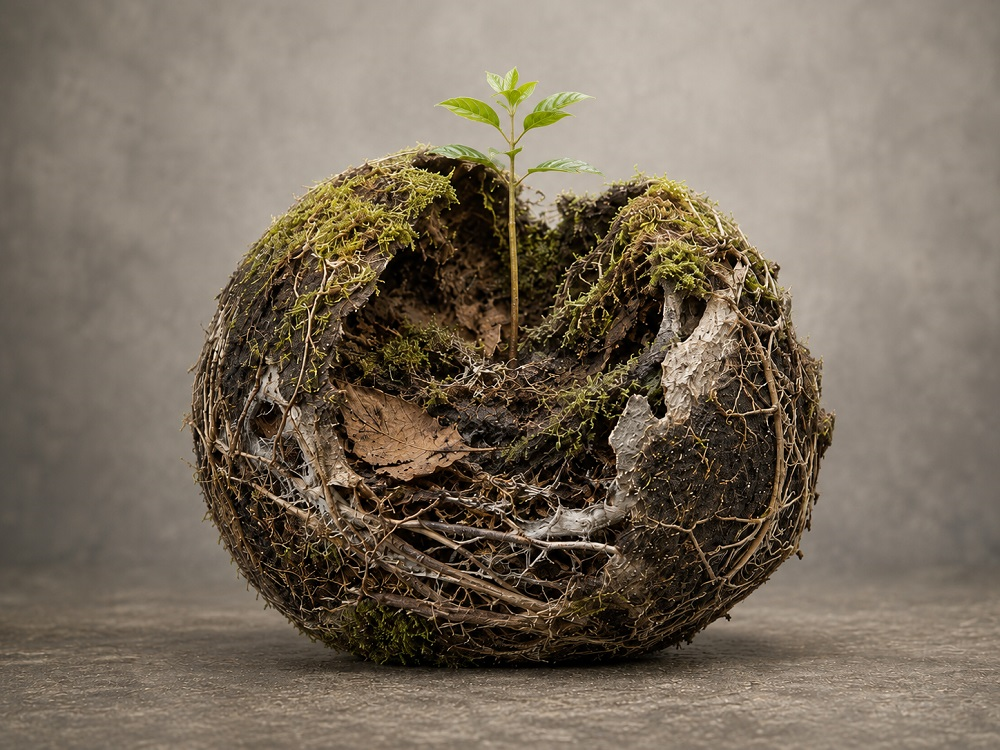
Still, conditions change. This morning, beneath a cluster of low shrubs, I found a small tree growing without stakes, protection, or encouragement from me. I do not know yet what species it is. Its stem is thin, and two of its leaves have already been eaten.
It is not the forest. But the ground beneath it was ready enough for it to begin.
Complexity depends on sequence. Not hierarchy. Not obedience. Timing.
Forests do not skip steps. They make the next step possible.