Home > Critical notes > From Quisquiza (07 of 20)
From Quisquiza (07 of 20)
Orchids
Roots That Do Not Dig
This note is part of a series written from Quisquiza, in the high-Andean cloud forest of Colombia, where ecological restoration and research now unfold side by side. It reflects on how living and working within this terrain gradually reshapes the way I think about memory, information, and the infrastructures built to sustain them. Check all the notes in this section's index.
Not all the orchids here in Quisquiza grow on the ground. In fact, most live high above it.
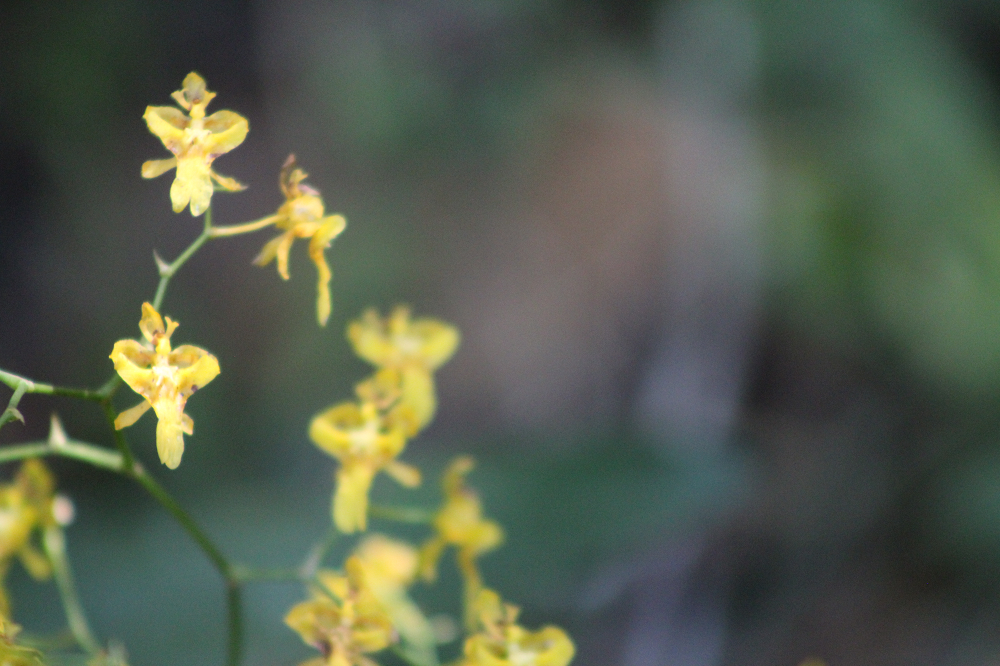
Like the one popularly known as "lluvia de oro" ("golden shower") that abounds on the native trees of my land. Hundreds and hundreds of tiny, yellowish, divine flowers. One of the more than three hundred species of the genus Oncidium.
They are epiphytic. They cling to branches, trunks, old bark, mossy forks, fallen limbs, and sometimes to surfaces where one would not expect anything so precise (and delicate, and incredible, and beautiful and...) to survive. Their roots do not descend into soil; they grip, curve, suspend themselves, and remain exposed to fog, rain, air, insects, fungi, and whatever else the mountain decides to throw at them.
At first glance, they seem fragile. Thin stems. Small leaves. Roots hanging in the open, pale and almost imprudent, as if someone had forgotten to cover them properly.
But that first impression is misleading.
Epiphytic orchids are not weak. They are specialists in attachment without possession. Their roots cling to bark without penetrating it as ordinary roots penetrate soil. They absorb moisture from fog, rain, and the humid air of the cloud forest. Many are wrapped in a spongy outer tissue that drinks quickly when water appears and dries again when it vanishes.
Efficient, theatrical, slightly ridiculous.
(And absolutely beautiful. Trust someone who has spent hours looking at them through a microscope.)
The important thing is this: they do not need to own the surface that sustains them.
They do not turn bark into property. They do not exhaust the branch. They do not demand depth where depth is not available. Their stability comes from precision, timing, and lightness. They attach where conditions allow, receive what the environment offers, and remain capable of surviving in suspension.
That changes how one thinks about anchoring.
Most of us imagine stability as depth. Roots going down. Foundations. Weight. Occupation. A firm claim over substrate. The deeper the root, the stronger the life.
But orchids elegantly challenge that idea.
Here, stability can be aerial. Attachment can be lateral. Continuity can depend less on possession than on relation. What matters is not how much ground one occupies, but how well one reads the surface, the moisture, the shade, the angle, the living structure already there.
Epiphytes are not independent in the heroic sense. Nothing up here is. They depend on trees, fog, light, fungal associations, air movement, and accumulated organic particles caught in bark and moss. But dependence does not automatically mean extraction. "Living with" does not have to become "taking from."
That distinction actually matters. Many human systems confuse anchoring with occupation. Institutions arrive and dig. Projects arrive and extract. Classifications arrive and overwrite. Platforms arrive and absorb. They call it integration, infrastructure, access, innovation, development.
Sometimes it is simply occupation with good cosmetics.
Knowledge & memory management often behaves as if stability required control over the substrate: the archive, the community, the language, the collection, the territory, the memories. To preserve something, we seize it. To describe it, we detach it. To make it usable, we force it into our own structures.
The orchid suggests another possibility.
A system can attach without enclosing. It can receive without exhausting. It can remain present without claiming ownership of the surface that allows it to exist. It can build continuity through careful contact rather than accumulation.
That does not make it harmless by default. Nothing alive is. Orchids still compete for light, space, moisture. They still participate in tension. But their form of attachment reveals a different grammar of presence: one based on contact, adjustment, and restraint.
Up here, surrounded by branches carrying small aerial worlds, it becomes harder to believe that every structure must begin by digging foundations.
Some forms of knowledge should not dig. Some should learn to cling lightly, drink from fog, leave the bark alive, and remain humble enough to know that support is not the same as possession.