Home > Critical notes > From Quisquiza (03 of 20)
From Quisquiza (03 of 20)
Ground
When Soil Compacts
This note is part of a series written from Quisquiza, in the high-Andean cloud forest of Colombia, where ecological restoration and research now unfold side by side. It reflects on how living and working within this terrain gradually reshapes the way I think about memory, information, and the infrastructures built to sustain them. Check all the notes in this section's index.
When Semana Santa, the Holy Week, is around, the rainy season starts in the Andes — the jallu pacha in Aymara, the paray tiempu in Quechua.
And with it, the planting season.
In all the Andes. Including Quisquiza.
"You have to plant maize and beans with the waning moon," peasants have been telling me for a month now. In the place where I was born, it's with the waxing moon. I understand there's a reason for everything, but it's funny to see the differences...
But I'm not sure I can plant anything this year. Not because of the moon. Because of the ground.
The soil is degraded. And when it is —by years and years of cows, for example, like in my piece of land— you can see it.
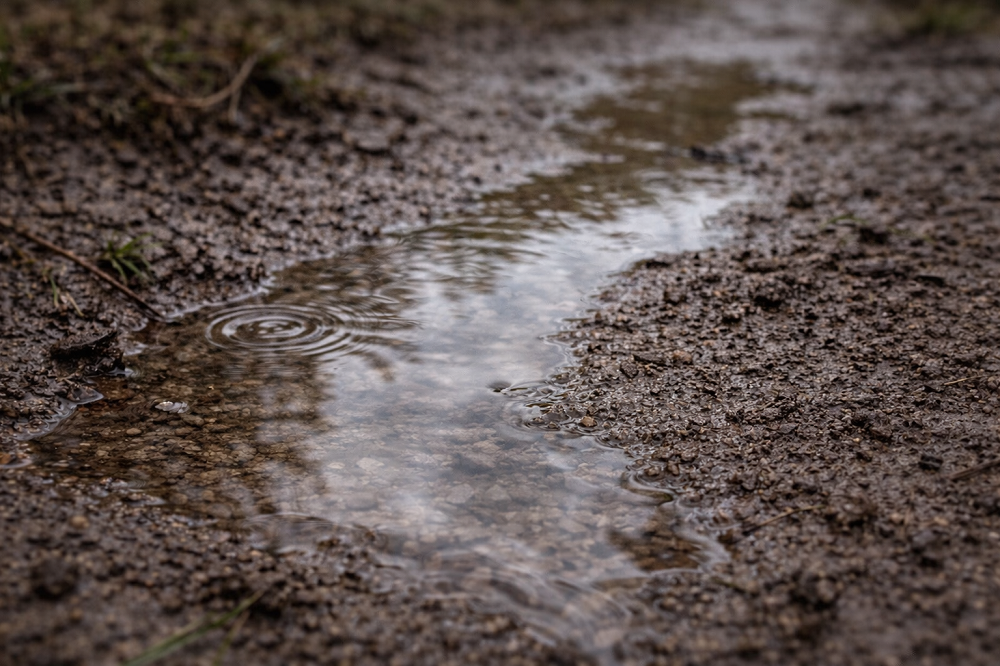
It is... compacted. Water seems to run off instead of entering. Organic matter definitely thins. Roots hesitate at the surface — then, of course, give up. Diversity narrows; just a handful of plants and animals can handle that kind of structure.
Step on it after rain and, I swear, it does not yield. It resists.
(It also stains your boots in a very particular way. Clay remembers.)
In some areas around my house, I can push a taqlla —an old, wooden indigenous tool— or a shovel —an old... well, you know what it is— into the ground and feel the exact moment where it stops. A few centimeters below the surface.
It's a thin layer, dense and silent, that refuses entry. Above it, things try. Below it, nothing moves.
Restoration begins below the surface. Before planting anything ambitious, the structure has to change. I am talking aeration, patience, organic input, patience, plants with taproots, patience, time, patience.
Needless to say, you cannot demand complexity from a substrate that has been simplified.
Working with damaged soil makes something obvious: extraction leaves traces that persist long after activity stops. Compaction is not dramatic. It does not announce itself. It accumulates quietly — step by step, season by season — until movement becomes difficult, and then impossible.
Systems built on depleted foundations behave in similar ways. They may look intact from above, from the outside. They may even appear productive for a while. But beneath that surface, circulation is restricted. Nothing penetrates. Nothing anchors properly.
Recovery is slow because it starts where little is visible. The base layer has to be rebuilt before anything else can stabilize.
(Add organic matter. Wait. Watch. Repeat. There is no shortcut here. I know. I checked.)
Archivists and librarians know this pattern.
Metadata schemas, cataloguing traditions, institutional mandates, funding logics — these form the substrate of our work. They accumulate over decades. They stabilize practice.
They also compact.
Under pressure — standardization, efficiency, scale — they harden. They begin to resist what does not fit. New categories fail to enter. Marginal knowledge stays at the surface, unable to root. Diversity becomes a decorative layer instead of a structural condition.
No amount of new tools or digital layering changes that. Interfaces improve. Access expands. The surface looks better. But below, the same density remains.
Working up here makes something difficult to ignore: if the ground does not breathe, nothing else matters.
The work is not to plant more. It is to open the soil. Only then may anything had a chance of holding.