Home > Critical notes > From Quisquiza (01 of 20)
From Quisquiza (01 of 20)
Coordinates
Where the Fog Enters
This note is part of a series written from Quisquiza, in the high-Andean cloud forest of Colombia, where ecological restoration and research now unfold side by side. It reflects on how living and working within this terrain gradually reshapes the way I think about memory, information, and the infrastructures built to sustain them. Check all the notes in this section's index.
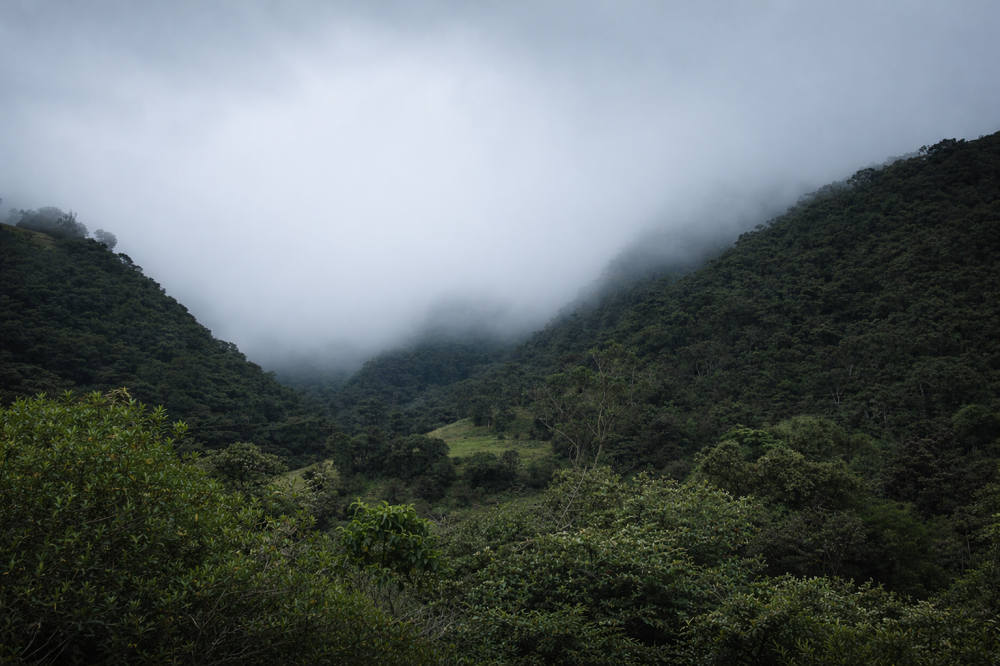
Since January 2026, I have been living and working in Quisquiza, high in the Eastern Colombian Andes, within native cloud forest and not far from the páramo of Chingaza National Natural Park — the high-altitude ecosystem that supplies water to Bogotá and its eight million inhabitants.
Historical records identify this as Muisca territory. The presence is not abstract. It persists in names (like "Quisquiza" itself), in plant and animal terminology, and in fragments of language still attached to the land.
Part of the terrain around my house is under ecological restoration. The forest beyond it is not. It remains dense, inhabited, structurally intact. Spectacled bears move through these mountains.
(That fact does not feel entirely theoretical at night.)
Fog enters the kitchen without asking permission. Insects cross the house as if walls were suggestions. On most days, within a few meters of my desk, I encounter plant species I cannot immediately name.
(The limits of knowledge feel closer here.)
Climate, altitude, soil recovery, and daily contact with biodiversity do not remain outside my work. They enter it. Systems are no longer diagrams pinned to a wall; they are slopes that drain poorly, seedlings that hesitate at 8°C, roots that refuse compacted soil.
Sometimes they cooperate. Sometimes they do not.
(I am looking at you, Kikuyu grass.)
Quisquiza is not background. It is the condition within which my work now unfolds — writing, research, lectures, music, art, doubts. Territory does not illustrate theory here. It interferes with it. Something shifts.
If you follow this space, you will see how this place enters the language itself — not as metaphor, but as pressure — reshaping how I think about memory, information, and the structures that hold them.