Home > Critical notes > Dealing with Literocentrism (10 of 10)
Dealing with Literocentrism (10 of 10)
The Page Cannot Hold the Dance
Toward Plural Infrastructures of Memory
This note is part of a series that critiques the cult of literacy in libraries — exposing how reading, writing, and the book have been crowned as the only valid forms of knowledge, while everything else is silenced, excluded, or reshaped to fit the page. Check all the notes in this section's index.
Memory That Moves
Libraries have long imagined memory as something fixed: a trace to be stored, cited, and retrieved. This assumption shaped the shelves, the catalogues, the workflows, and the policies. Memory became a page, and the page became the template for everything else.
But not all memory holds still. Some of it trembles. Some of it sings. Some vanishes the moment it's observed. Some lives only in the repetition of movement, the cadence of a voice, or the warmth of a body in space.
To serve this kind of memory, a library must be more than a house for books. It must become a space where what cannot be printed is not just tolerated, but centered. That shift is not merely poetic; it requires rethinking the very systems we build.
Beyond Inclusion, Toward Redesign
Most attempts to "diversify" libraries treat exclusion as a curatorial gap: a matter of missing items to be acquired. Oral traditions are added as collections. Embodied knowledge becomes an exhibit. Communities are invited to participate in systems never meant for them.
This does not dismantle literocentrism. It renovates it.
A truly plural library must begin not with content, but with design. With systems that do not reduce memory to a document. That do not convert presence into text. That do not pretend a scan is a preservation, or that a transcript is a voice.
It means building catalogs that do not assume a single author, a linear timecode, or a standardized format. It means allowing for archives that vanish, for stories that contradict themselves, for knowledge that resists being dismembered and filed.
It means letting memory define its own architecture.
The Shapes of a Plural Library
A plural library might contain rooms where listening is the primary mode of access; networks where elders are not asked to donate content, but to remain present; collections organized not by subject or title, but by rhythm, relation, or geography; archives of smell, silence, or absence; objects that do not explain themselves; events that are not recorded; songs that are not transcribed; knowledge that does not seek to endure — only to be felt.
These are not fantasies. They are already practiced in many communities: Indigenous, diasporic, disabled, intergenerational. The question is not whether such knowledge exists. The question is whether libraries can stop asking it to become paper.
Letting Go of the Page
This series began with a premise: that reading, writing, and the book have occupied the center of the library for too long. It ends with an invitation — not to eliminate them, but to uncenter them. To let them join a constellation rather than remain the axis around which all else must orbit.
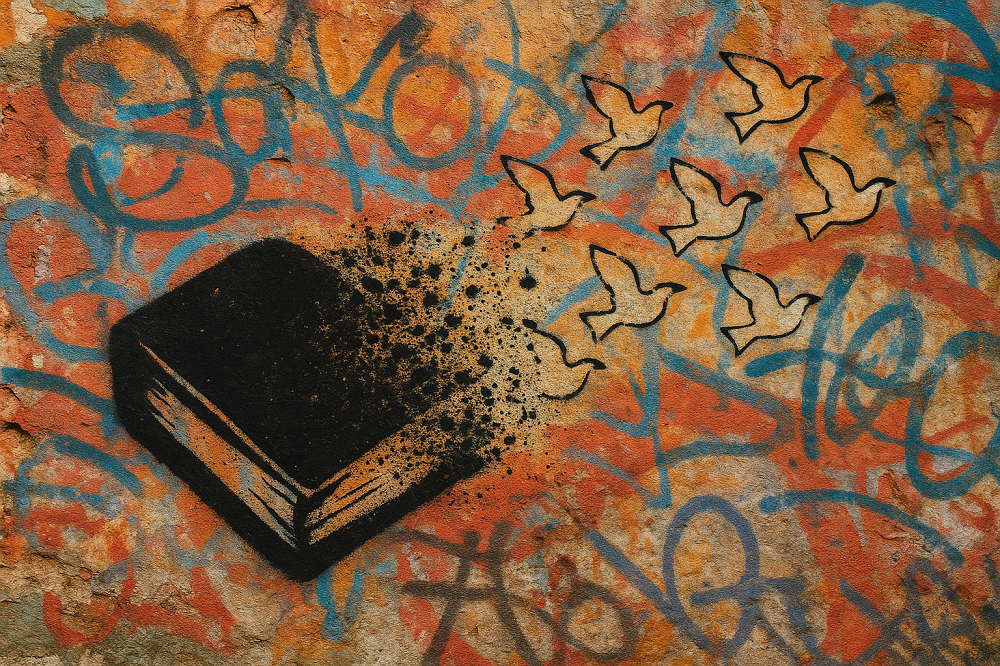
The page has done its work. It will continue to serve. But it cannot hold everything. It cannot hold the dance. It cannot hold the breath that was meant to vanish. It cannot hold the memory that dies when frozen.
A library that tries to print everything ends up preserving nothing fully.
The task now is to build something else — not from scratch, but from the fragments that have always been excluded. Not as an annex to the library we know, but as a different way of knowing what a library could be.