Home > Critical notes > Dealing with Literocentrism (08 of 10)
Dealing with Literocentrism (08 of 10)
Digital Literocentrism
When Ebooks Replace But Don't Transform
This note is part of a series that critiques the cult of literacy in libraries — exposing how reading, writing, and the book have been crowned as the only valid forms of knowledge, while everything else is silenced, excluded, or reshaped to fit the page. Check all the notes in this section's index.
The Screen as Mirror, Not Portal
When libraries digitize, they often claim transformation. They speak of access, modernization, inclusion. The image is compelling: knowledge unbound from paper, circulating freely through servers and screens. A global library, searchable and immediate.
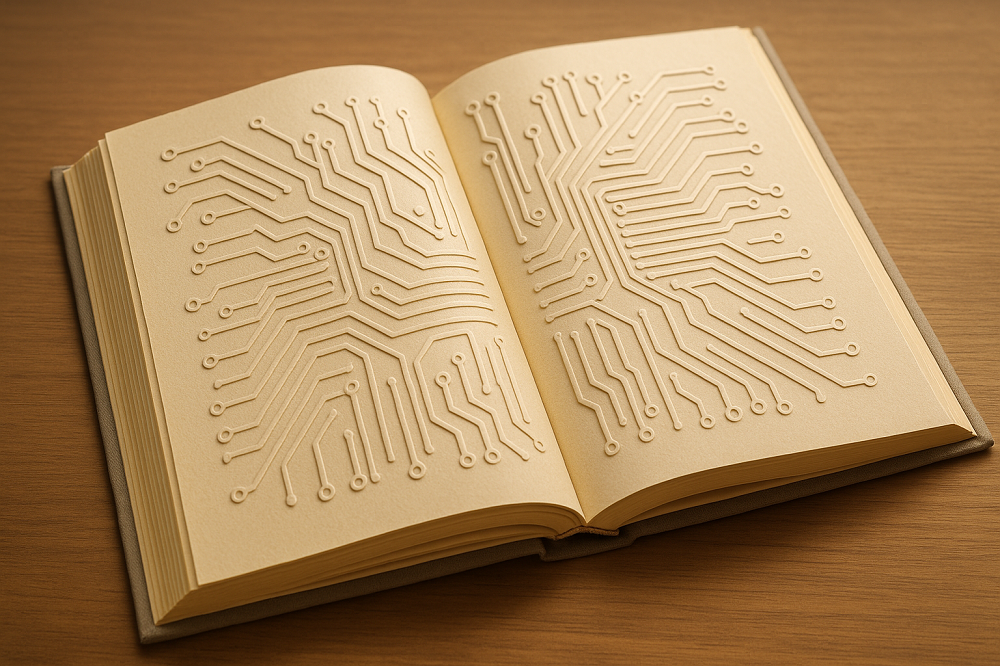
But in most cases, what digital libraries offer is not transformation — it is reproduction. The screen becomes a mirror of the page. The infrastructure remains book-shaped. The logic remains literate.
Digital collections are dominated by formats that replicate print conventions: EPUBs, PDFs, scanned pages with OCR layers. Content is structured into chapters, citations, and bibliographies. Interfaces are designed to search for keywords, filter by author, and link to DOI-based records. The user experience is built for reading. And everything outside that mode is peripheral — or excluded entirely.
The promise of the digital library is often nothing more than the book in drag.
When Access Means Text Only
The shift from shelves to servers does not automatically expand epistemic access. It expands access only to the already-encoded. Only to the already-literate. Only to the already-citable.
Digitization campaigns prioritize textual documents: manuscripts, government records, journals, monographs. Even when they include oral or visual materials, they do so under the condition of translation — a transcript, a caption, a metadata record.
An interview is included if it has a written summary. A song is stored as an MP3 only if it's been indexed by title and theme. A video of a ritual is hosted, but buried, because the search system was never meant to find gestures. The interface does not listen. The algorithm cannot feel.
Even when libraries host rich media collections, they often treat them as exceptions. Oral archives are "special projects." Sound recordings are "supplements." The real library — the core infrastructure — still runs on text.
Digital Infrastructures, Analog Bias
The problem runs deeper than format. It is also architectural.
Library platforms — OPACs, discovery layers, institutional repositories — are all designed around bibliographic metadata. They expect a specific kind of content: authored, titled, dated, classified. When material does not fit those parameters, it is forced into compliance. Or it is excluded.
This bias is inherited from analog systems, but it becomes more powerful in digital space. At least in a physical library, a user might stumble upon something unexpected. In a digital interface, what cannot be searched might as well not exist. What cannot be indexed cannot be found. What cannot be queried cannot be known.
Digitization without epistemic pluralism is not liberation. It is compression.
Beyond the Simulated Book
The digital library could be a space of radical inclusion. It could host oral traditions with their own indexing systems. It could prioritize listening over scanning. It could build archives of silence, sound, movement, and disappearance. It could treat embodied knowledge as something more than an annotation.
But that would require more than converting books into files. It would require questioning the very premise of what a library holds — and how it holds it.
The EPUB is not the end of the book. It is its afterlife. And like many ghosts, it refuses to let go.
Until libraries stop mistaking format for transformation, they will remain bound — not by paper, but by the logic of print.