Home > Chronicles of a biblio-naturalist > Biomimesis in Action (10)
Biomimesis in Action (10)
Water Stored in Air
Tank bromeliads and opportunistic infrastructure
A Pool Above the Ground
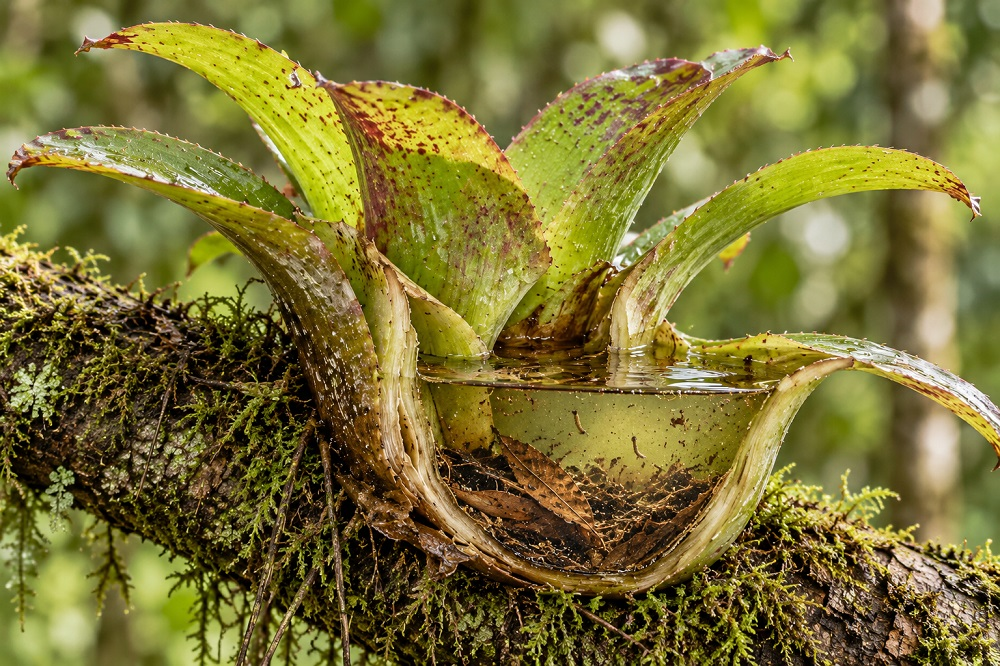
High in a tropical forest, water can remain after the rain has stopped. It rests between overlapping leaves, catches fallen fragments of vegetation, and becomes a place where small animals live and feed. The pool belongs neither to a stream nor to the soil. It has formed inside a plant attached to a tree.
The plant is a tank-forming bromeliad. It uses a branch or trunk as support, but its reservoir is made from its own leaves. Rain that would otherwise pass through the canopy is held for later use. Material washed from surrounding vegetation enters the same space. A resource that arrives irregularly becomes available locally for longer.
This is an unusual arrangement of infrastructure. The bromeliad does not need to grow a tree, command the weather, or establish a patch of ground before it can retain water. It develops a useful structure within conditions it does not control. For libraries, archives, and other fragile knowledge projects, the relevant question is similarly specific: what capacities can be built on existing supports, without first acquiring a permanent institution to house them?
A Tank Made of Leaves
Bromeliads are a diverse plant family, and not all of them form water-holding tanks. Some species obtain moisture from rain, fog, or humid air using specialized leaf surfaces without retaining a substantial external pool. The plants considered here are the tank-forming species, including many epiphytes that grow upon trees without drawing their nutrition directly from the host as parasites do.
In these species, the broad bases of the leaves overlap to form a rosette of reservoirs. Water entering the canopy during rain or foggy conditions accumulates between the leaves together with particles, dissolved substances, and organic debris. Specialized leaf trichomes participate in absorbing water and nutrients from these reservoirs. Roots attach the plant to its support and, depending on species and developmental stage, may also contribute to uptake. The older description of epiphytic bromeliad roots as nothing but anchors is too simple (Takahashi and Mercier 2024).
The tank does not remove the uncertainty of rainfall. It modifies its consequences. Measurements across more than two hundred bromeliad species documented tank capacities ranging from only a few millilitres to nearly five litres, with plant size an important predictor of capacity (Zotz et al. 2020). Such variation matters: a small reservoir may empty quickly, while a larger one can bridge a longer interval between showers. Neither can supply water indefinitely.
The essential mechanism is therefore not abundance. It is the conversion of a short-lived arrival into a temporary reserve. The plant captures an opportunity at the moment it passes and changes the time over which that opportunity remains useful.
A Reservoir That Becomes a Habitat
A bromeliad tank is not simply a container for the plant's private use. Its water may support bacteria, fungi, algae, insects, and other small organisms. Some animals visit to drink; others spend part of their life cycle in the reservoir. Fallen leaves and other organic matter enter the water, where microbial and animal activity helps transform them into forms that can circulate through the small food web. Research on phytotelmata, the bodies of water held by living plants, has made these miniature systems especially useful for studying ecological communities (Kitching 2001).
The reservoir also supports biological activity that can affect the plant's access to nutrients. These relationships vary; a tank does not guarantee a particular animal community or uniformly beneficial exchanges (Ladino et al. 2019).
For a knowledge project, this suggests a second possibility. An improvised support may do more than shelter materials. A borrowed room can become a place where records are described; a community radio station can help gather testimony; a shared computer can host a temporary catalogue; a meeting point can connect people who previously held separate parts of a history. The support does not merely keep a project alive. Under suitable arrangements, it changes what the project can do.
But a borrowed room is not a bromeliad tank. Its functions depend on agreements, labor, access rules, and people's willingness to participate. The ecological mechanism identifies a way to frame the design problem; it cannot supply the social agreement that makes the design legitimate.
Building Without Owning the Ground
Many knowledge initiatives begin with a familiar sequence of institutional demands: secure a building, buy equipment, maintain a platform, appoint staff, and only then start collecting or organizing materials. Stable infrastructure can protect work and clarify responsibility, but those demands may delay a project indefinitely.
The bromeliad suggests a different sequence: identify what the surrounding environment already provides, locate where resources arrive, and construct a small capacity able to capture them. The result is neither complete independence nor mere dependence. It is a local system joined to a larger one, with functions of its own.
Such an approach could matter for a territorial archive spread across several communities. One place may offer a room that is available monthly. Another may have reliable electricity but no public space. A third may have a librarian who can maintain descriptions but limited digital storage. A fourth may have an internet connection for only a few hours each week. None is capable of supporting a conventional archival institution alone. Together, they may provide the conditions for several modest, linked activities.
The aim would be to design points of collection, description, consultation, and transfer around real local capacities. An arrangement that works on a school computer need not be identical to one operating from a community library. What must remain compatible are the records of what was received, how it was described, who may access it, and where another authorized copy or responsible custodian can be found.
This differs from dispersing copies simply to reduce the risk of loss. The point is to let existing places support activities that would otherwise require a purpose-built center. A host provides a condition of possibility; the project adds a limited, identifiable function.
A Field Archive with Several Tanks
Consider a small project documenting changes along a watershed. Residents contribute photographs of banks and vegetation, audio observations of seasonal events, and written descriptions of local names. The work has no permanent office, and participation rises and falls with weather, travel, and availability.
A conventional response might be to wait for funding for a central repository. A bromeliad-informed design would begin instead with the resources already present. At a school, a monthly session could receive materials and record basic provenance. A community library might maintain a controlled descriptive register. A local association could offer temporary equipment for reviewing recordings. When connectivity becomes available, authorized copies and updated descriptions could be transferred to another custodian.
Each location would need a modest, defined procedure rather than an entire archival platform: identify a contribution, register its origin, record restrictions and permissions, preserve enough context for later interpretation, check that a transfer completed correctly, and document who is responsible until the next transfer. Files requiring protection would not be placed on an unprotected shared computer. When a host withdraws its support, the project would need a rehearsed method for removing its materials and transferring its responsibilities.
This is a design proposal, not a practice validated by bromeliad research. Its value would have to be assessed against a realistic alternative. Does it capture evidence that would otherwise be lost? Do contributors retain meaningful control? Does the arrangement reduce costs or merely shift unpaid work onto local partners? Can materials still be found and interpreted when one host leaves? Answers to those questions, not botanical resemblance, would determine whether the transfer was worthwhile.
The Branch Has Conditions
Epiphytic bromeliads do not possess the trees that support them, but neither are they free of their conditions. Their establishment depends on suitable surfaces, light, moisture, and a canopy that persists. Tanks can dry. Trees can fall. Changes in forest structure can remove the very places where the plants can live. Epiphytes are generally not parasites of their hosts, yet that does not mean their presence is always without ecological effects.
In human systems, the distinction between support and control becomes much sharper. A school, library, association, or household is not an inert branch. It has owners or custodians, obligations, limited resources, and the right to refuse additional work. Calling a structure underused does not make its capacity available for appropriation. A project that depends on unpaid labor or uncertain permission may be cheap only from the viewpoint of its organizers.
Opportunistic infrastructure therefore requires agreements rather than assumptions: who may place material where, for how long, under what protections, with what compensation or reciprocal benefit, and with what procedure for withdrawal. It also requires attention to unequal power. If the most technically capable host eventually acquires exclusive control over records contributed by others, an apparently distributed system may reproduce centralization by quieter means.
Bromeliads offer no model of consent, public accountability, or archival rights. Those remain human responsibilities, and no biological comparison can decide them.
What the Canopy Makes Possible
The important feature of a tank bromeliad is not its freedom from dependence. It is the particular way it depends: attaching to an existing structure while creating a smaller reservoir with its own capacity to gather, retain, and support life. Its form allows intermittent resources to persist locally without requiring control over the larger environment.
Knowledge systems built under precarious conditions may benefit from a comparable design principle. Instead of waiting for permanent property, comprehensive infrastructure, or an uninterrupted budget, they can identify available supports and develop bounded capacities around them. Those capacities must be portable enough to survive withdrawal, explicit enough to remain accountable, and useful enough to justify the demands they place on their hosts.
Water is not literally stored in the air. It is held above the ground, in a structure that knows how to catch what passes through. The distinction matters. There is no miracle of independence here, only an effective arrangement of dependence.
Bibliography
- Kitching, R. L. 2001. "Food Webs in Phytotelmata: 'Bottom-Up' and 'Top-Down' Explanations for Community Structure." Annual Review of Entomology 46: 729–760.
- Ladino, Geraldine, Fabiola Ospina-Bautista, Jaime Estévez Varón, Lucie Jerabkova, and Pavel Kratina. 2019. "Ecosystem Services Provided by Bromeliad Plants: A Systematic Review." Ecology and Evolution 9 (12): 7360–7372.
- Takahashi, Cassia Ayumi, and Helenice Mercier. 2024. "New Insights into the Role of the Root System of Epiphytic Bromeliads: Comparison of Root and Leaf Trichome Functions in Acquisition of Water and Nutrients." Annals of Botany 134 (5): 711–724.
- Zotz, Gerhard, Maxi Leja, Yonatan Aguilar-Cruz, and Helena J. R. Einzmann. 2020. "How Much Water Is in the Tank? An Allometric Analysis with 205 Bromeliad Species." Flora 264: 151557.