Home > Chronicles of a biblio-naturalist > Biomimesis in Action (02)
Biomimesis in Action (02)
The Desert Remembers in Fragments
Seed banks and persistence through rarity
The Fiction of Constant Presence
Many knowledge systems are imagined as if their value depended on continuous presence. They are expected to remain visible, searchable, updated, cited, funded, staffed, and institutionally recognized. A collection that is not seen begins to look inactive. A project that does not publish begins to look abandoned. A database that stops growing begins to look obsolete. A memory practice that survives in scattered forms begins to look incomplete.
This expectation is understandable, but it is also dangerous. It confuses continuity with constant appearance. It assumes that a system persists because it remains present in one stable form, under one recognizable authority, through one active interface. It makes survival look like uninterrupted display.
But many fragile knowledge systems do not persist that way. They persist in pieces.
A community archive may survive through boxes kept in different houses. A language project may survive through copies of recordings held by several people, none of them complete. A local classification may survive in filenames, notebooks, oral explanations, old spreadsheets, and habits of use. A threatened memory system may not remain active as an institution, a platform, or a public catalogue. It may survive as dispersed possibility: enough fragments, in enough places, with enough legibility, to make future recovery possible.
This kind of persistence is difficult to recognize because it does not look like continuity from a distance. It looks partial, uneven, irregular, and sometimes almost absent. Yet absence is not always emptiness. In some systems, what matters is not that everything remains visible, but that not everything disappears at once.
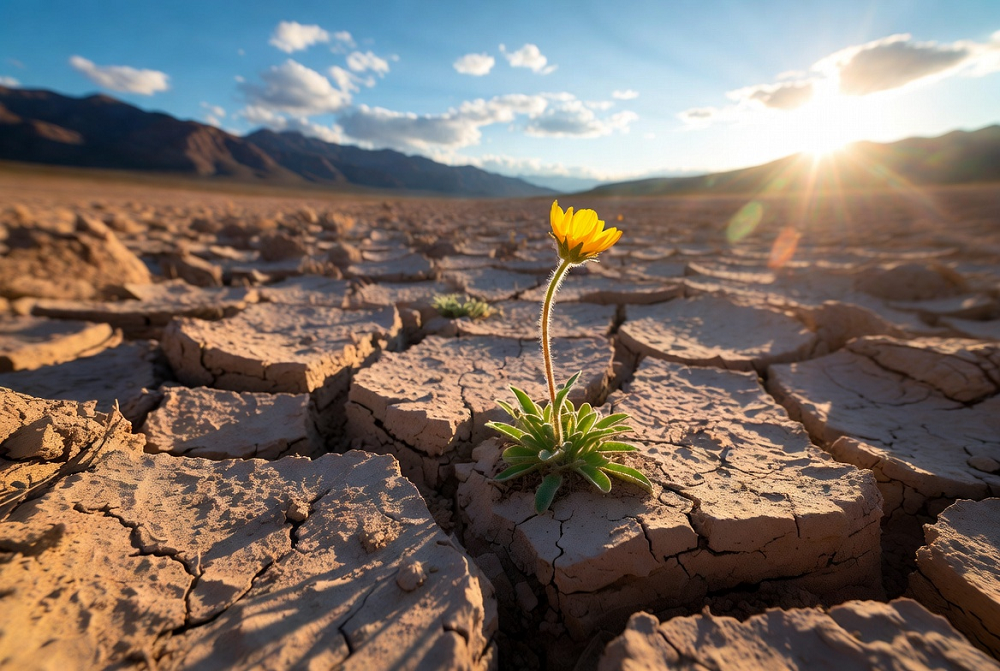
Desert seed banks clarify this with unusual force. In dry and unpredictable environments, continuity cannot depend on every seed germinating when the first opportunity appears. Rain may come and vanish. A wet surface may deceive. A good beginning may become a lethal season. Under those conditions, survival depends partly on restraint. Some seeds germinate. Others remain in the soil. The population does not place its whole future in a single event.
The desert remembers in fragments.
When Rarity Is Not Weakness
A seed bank is not a vault in the usual sense. It is not a clean storage room beneath the soil, where life is neatly catalogued and waiting. It is a scattered, vulnerable, uneven reserve of possibility. Seeds may be buried at different depths, carried by wind, moved by water, eaten by animals, damaged by heat, infected by fungi, or lost before they ever germinate. Some remain viable. Others do not. Some respond to rain, light, temperature, disturbance, or chemical cues. Others remain dormant even when conditions appear favorable.
This is efficiency. In unpredictable environments, uniform response can be fatal. If every seed germinates after one rain, and the rain is followed by drought, the entire cohort may die. The apparent opportunity becomes a trap. By holding back part of the population, the system reduces the risk of total loss. The future is not concentrated in one moment. It is distributed across time.
Rarity, then, is not simply a sign of weakness. A plant that appears only after rare rains may not be poorly adapted. It may be organized around a different rhythm of appearance. Its continuity does not depend on constant abundance above ground. It depends on the persistence of a hidden reserve, scattered through soil, waiting for conditions that cannot be commanded.
This matters for knowledge systems because we often confuse institutional abundance with survival. We trust what has offices, websites, staff, policies, metrics, and public visibility. We distrust what survives in fragments, copies, partial records, remembered procedures, local terms, and scattered custodianship. We treat dispersed memory as a problem to be corrected by centralization.
Sometimes it is a problem. Fragmentation can be the result of violence, neglect, underfunding, extraction, displacement, censorship, or institutional collapse. It should not be romanticized. But dispersion can also become one of the few available forms of survival when stable support does not exist. A fragile system may not be able to maintain one strong center. It may need to persist through many weak traces.
The question is not whether fragmentation is good, but whether the fragments remain capable of relation.
The Soil as Delayed Population
The visible plant community in a desert is only one layer of the system. What appears after rain is not the whole population. Beneath the surface there may be seeds from previous seasons, previous plants, previous failures, and previous opportunities that did not become visible. Some seeds belong to species that may not appear above ground for years. Some may wait through bad seasons. Some may germinate only when a particular combination of conditions occurs.
The standing vegetation is therefore not identical with the system's memory. What is visible at any given moment may be only a temporary expression of a deeper, more dispersed continuity.
This is a useful warning for archives, repositories, catalogues, and cultural memory projects. The public interface is not the whole system. The active institution is not the whole system. The current version is not the whole system. A project's continuity may also live in backups, exports, inventories, correspondence, community copies, old hard drives, printed lists, teaching materials, oral explanations, and local practices that never entered the official platform.
A knowledge system that appears small, inactive, or broken may still contain a delayed population of possible futures. It may hold enough scattered structure to be reactivated, reinterpreted, repaired, or rebuilt. But this depends on the quality of the fragments. A seed that has lost viability is only residue. A file that cannot be opened, a metadata field that cannot be interpreted, a collection without provenance, a password known by no one, a category whose meaning was never documented: these may look like traces, but they may not be recoverable.
The soil remembers, but not everything buried remains alive.
For fragile knowledge systems, the equivalent problem is not simply duplication. It is viable dispersion. Copies must be usable. Descriptions must be intelligible. Fragments must contain enough context to reconnect. A spreadsheet without a data dictionary may survive as a file and fail as knowledge. A set of recordings without speaker information, permissions, dates, or local names may persist materially while losing much of its relational value. A folder structure may remain intact while its logic disappears.
Persistence through fragments requires more than scattering. It requires fragments that carry the conditions of future relation.
Designing for Dispersed Possibility
Many preservation strategies still imagine survival through consolidation. Gather the materials. Build the platform. Standardize the metadata. Centralize the repository. Stabilize the interface. Secure the institution. These moves can be necessary, especially when materials are endangered, dispersed without control, or at risk of physical loss. But centralization is not always possible, and it is not always safe.
Some knowledge systems exist in conditions where a single center would be fragile. A repository may depend on one grant. A server may depend on one technician. A community archive may become vulnerable if everything is held by one institution. A politically sensitive collection may be safer if no single seizure, failure, or betrayal can destroy it. A small project may not have the capacity to maintain a formal repository, but it may be able to maintain several usable copies, distributed among trusted custodians.
In these cases, the design question changes. Instead of asking how to gather everything into one stable place, we may need to ask how to make dispersion survivable.
That means deciding what should exist in more than one location, in more than one format, under more than one form of custody. It means designing small packets of recoverable structure: files with clear names, open formats, inventories, rights notes, contextual explanations, checksum lists, local terminology, custodial histories, and instructions for future handling. It means making sure that a fragment is not merely a fragment of content, but a fragment of orientation.
A seed contains more than matter. It contains a compressed future: enough organization to resume growth under certain conditions. A knowledge fragment should aspire to something similar, without pretending to be biological. A folder, file, recording, dataset, or inventory should not only exist. It should tell a future custodian what it is, where it came from, how it relates to other materials, what restrictions apply, and what would be damaged by careless use.
This is not glamorous work. It is not the shining layer of digital heritage. It is not the public portal, the exhibition, the interface, or the institutional announcement. It is the dirt work of persistence: naming, exporting, duplicating, explaining, printing, labeling, packaging, and leaving enough traces for someone else to continue.
Not Everything Should Germinate
The seed bank also challenges another preservation fantasy: the idea that every preserved element should become active as soon as possible. In knowledge work, this appears as the pressure to publish, expose, digitize, upload, share, activate, mobilize, and make accessible. Access matters, but immediate activation is not always the highest good.
Some materials should not be made public. Some records require community review. Some names, songs, places, rituals, or testimonies may need restricted circulation. Some collections may need to remain quiet until legal, ethical, technical, or political conditions change. Some projects may not have the capacity to serve users responsibly even if they possess valuable materials. Some knowledge may survive precisely because it has not been forced into premature exposure.
The seed bank offers a disciplined way to think about this without turning secrecy into mystique. Not every seed germinates at the first rain because not every rain can sustain life. Not every knowledge fragment should enter public circulation just because publication is technically possible. The question is not only whether activation can occur, but whether the conditions can support it without producing damage.
This is especially important for fragile archives and community memory projects. A collection may need different states: active, dormant, restricted, duplicated, embargoed, described, undescribed, locally accessible, publicly inaccessible, technically preserved but ethically closed. These states are not failures of preservation. They may be part of preservation.
The problem begins when inactive or restricted states are confused with neglect. A quiet record may be abandoned, but it may also be protected. A closed folder may conceal institutional laziness, but it may also respect a boundary. A dispersed set of copies may reflect disorder, but it may also reduce the risk of total capture.
The design task is to distinguish these conditions clearly. Silence should not become an excuse for disappearance. Restriction should not become a mask for institutional control. Dormancy should not become abandonment with better vocabulary. But activation should not be treated as an automatic virtue either.
Some futures are damaged by arriving too early.
Memory Without a Single Body
A seed bank does not preserve a plant as an individual body. It preserves a population's future as distributed potential. The continuity belongs less to a single organism than to a pattern of possible reappearance. This makes it an uncomfortable model for institutions that prefer stable objects, complete collections, and identifiable custodianship.
Fragile knowledge systems often have a similar problem. Their continuity may not reside in one authoritative copy. It may reside in overlap. One person has the recordings. Another has the permissions. Another remembers the names. Another knows why the categories were changed. Another has the old catalogue. Another has the printed inventory. Another has the trust of the community. Another has the technical skill to recover the files.
From an institutional point of view, this may look chaotic. From a survival point of view, it may be the only reason the system has not disappeared.
The danger is obvious. Distributed memory can fail if its parts cannot find each other again. People move, die, lose interest, lose devices, lose trust, lose access. Files degrade. Formats change. Conflicts split custodianship. Names are forgotten. Fragments become private relics. Dispersion without relation becomes dust.
This is why persistence through rarity requires connective tissue. Not a central authority that captures everything, but enough cross-reference to prevent isolation. A copy should indicate that other copies exist. An inventory should mention related materials. A README should identify custodians or roles, where appropriate and safe. A local term should carry an explanation. A restriction should say who can decide future access. A dataset should explain its fields. A recording should not be separated from the conditions of its making.
The goal is not to eliminate fragmentation. The goal is to keep fragmentation from becoming unintelligibility.
A desert does not need every seed to germinate. But the seed bank must remain a bank, not an accidental scattering of dead matter.
What the Desert Does Not Solve
The comparison has limits, and those limits are important. A desert seed bank is not an archive. Seeds are not files. Germination is not access. Dormancy is not ethics. Soil does not solve questions of custodianship, consent, colonial extraction, institutional responsibility, technological dependency, or political violence. Ecological mechanisms do not become social answers by being interesting.
The seed bank is useful only if it sharpens the problem. It helps us question the fantasy that continuity requires constant presence. It shows how survival may depend on partial activation, delayed response, distributed risk, and hidden reserves. It suggests that rarity is not always a defect, and that absence from the surface does not always mean disappearance.
But it does not justify neglect. It does not mean that underfunded archives should be left to survive as fragments. It does not mean communities should be forced to rely on precarious copies because institutions refuse responsibility. It does not mean dispersion is automatically better than infrastructure. Sometimes a seed bank exists because the desert is harsh. That does not make harshness desirable.
For fragile knowledge systems, the lesson is narrower and more demanding. If continuity cannot be guaranteed through constant institutional activity, then persistence must be designed differently. Some systems need reserves. Some need delayed activation. Some need distributed copies. Some need fragments that can survive apart without losing the possibility of relation. Some need to remain rare, quiet, or partially hidden until the conditions of return are less destructive.
Continuity does not always appear as abundance. Sometimes it waits as scattered viability, buried under hostile ground, carrying enough form to answer when the rain is finally real.