Home > Chronicles of a biblio-naturalist > Ecosemiotic Archivistics from the Cloud Forest (06)
Ecosemiotic Archivistics from the Cloud Forest (06)
Frailejones Know How to Wait
The Logic of Slow Preservation
Retention in a Harsh Environment
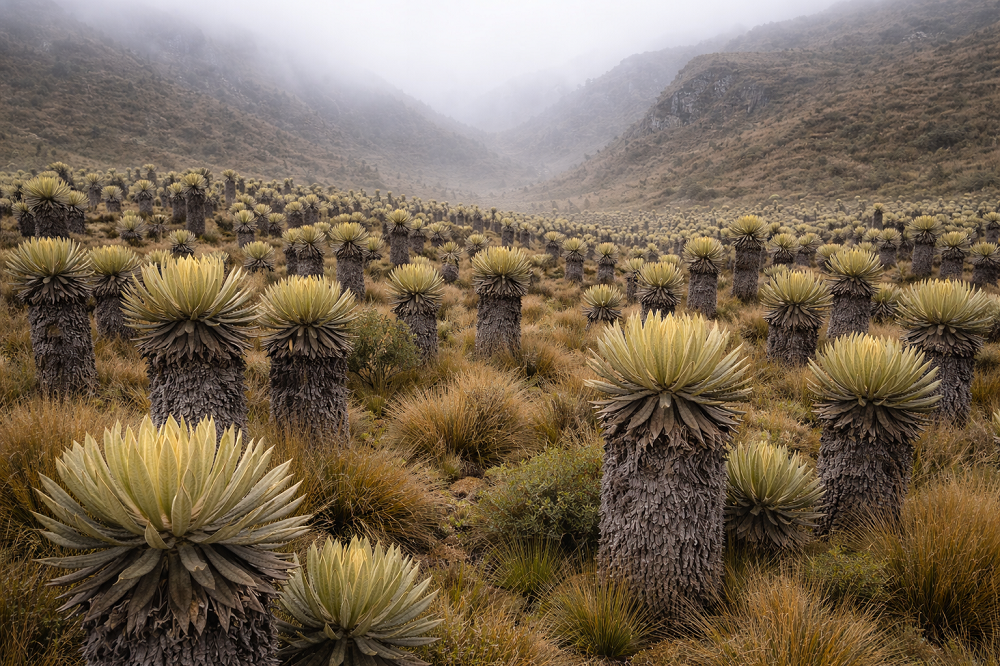
High-altitude páramo ecosystems, which occupy the transitional zone between the Andean cloud forest and the snowline, are defined by extreme environmental variability. Solar radiation is intense during the day, temperatures drop rapidly at night, and water availability fluctuates between saturation and evaporation. In this unstable climatic regime, certain plant species have evolved strategies not for rapid growth but for careful retention. Among the most distinctive of these are the frailejones (genus Espeletia and related taxa), large rosette plants whose thick stems and densely pubescent leaves capture atmospheric moisture and help regulate water movement within the páramo ecosystem.
Frailejones catch rainfall and mist within their dense rosettes and contribute to slowing the movement of water across the landscape. Their leaves are covered in fine hairs that reduce evaporation and intercept atmospheric moisture, while the vegetation structure they form helps regulate how water reaches the soil. Hydrological studies have shown that this vegetation, together with the highly organic soils characteristic of these ecosystems, plays a measurable role in regulating watershed dynamics by slowing runoff and allowing water to be released gradually into surrounding soils and downstream streams.
This ecological function reveals a distinctive form of environmental memory. Water is not merely absorbed and immediately used; it is held, moderated, and redistributed across time. The plant becomes a living interface between momentary climatic events and long-term hydrological continuity.
Storage Without Accumulation
The retention strategy of frailejones differs fundamentally from the logic of accumulation that characterizes many human storage systems. The plant does not collect water indefinitely, nor does it immobilize it. Instead, its structure slows the passage of moisture through the vegetation and soil before that water continues its circulation through the ecosystem. Retention, in this case, is temporary and functional rather than permanent.
This dynamic can be understood as a form of ecological buffering. Water captured during short periods of abundance is not stored as a static reserve but as a moderated flow that extends the availability of the resource beyond the moment of capture. The plant slows time within the hydrological cycle, ensuring that sudden influxes of moisture become sustained contributions to ecosystem stability.
In informational terms, such behavior suggests a preservation model that differs from archival fixation. The frailejón does not preserve water by isolating it from change; it preserves hydrological continuity by delaying transformation. The temporal extension created by this delay is the core of its ecological function.
Temporal Moderation as Memory Practice
The capacity of frailejones to regulate water release is the result of structural adaptations that unfold over decades. Individual plants grow slowly, often producing only a few centimeters of stem per year. Their leaves persist for extended periods before drying and forming insulating layers around the trunk. Over time, this accumulation of structural material enhances the plant's capacity to capture mist and retain moisture, effectively increasing its buffering function as it ages.
Through this gradual development, the plant integrates past environmental conditions into its present architecture. Years of exposure to fog, rainfall, and seasonal variability become embodied in the plant's physical structure. The resulting form is not a record in the conventional sense but a stabilized response to repeated climatic patterns.
In this way, frailejones participate in a form of temporal moderation. Rather than reacting immediately to environmental fluctuations, they convert episodic events into long-term processes. The hydrological memory of the páramo is therefore not stored in discrete units but maintained through the slow mediation performed by these plants.
Preservation Through Timing
In archival and library practice, preservation is frequently defined as the protection of materials against degradation. Environmental controls are designed to reduce chemical reactions, prevent biological damage, and stabilize objects so that their current state persists for as long as possible. The underlying assumption is that change threatens the integrity of the preserved item.
Ecological systems suggest a different perspective. In the páramo, water persistence does not result from preventing change but from carefully regulating it. Frailejones delay the passage of water through the landscape without attempting to stop its movement altogether. Their role is not to immobilize a resource but to pace its circulation.
This principle offers a useful conceptual parallel for thinking about long-term memory infrastructures. Preservation may depend less on preventing transformation than on controlling the tempo at which transformation occurs. When informational systems process change too quickly — through rapid obsolescence, uncontrolled data accumulation, or abrupt loss — they risk destabilizing the continuity of knowledge. By contrast, systems that moderate change can maintain coherence even as their contents evolve.
From this perspective, preservation becomes a question of timing rather than permanence. The goal is not to eliminate transformation but to structure it in ways that sustain continuity.
The Ecology of Slow Archives
The hydrological role of frailejones illustrates how environmental systems achieve resilience through temporal buffering. By slowing the movement of water across the landscape, these plants transform brief meteorological events into long-term ecological processes. The result is a stable flow regime that supports downstream ecosystems despite the volatility of high-altitude climates.
Such mechanisms provide a useful lens through which to reconsider the temporal design of memory institutions. Archives and libraries often struggle with two opposing pressures: the desire to retain information indefinitely and the practical necessity of managing continual change. Ecological systems resolve a similar tension not by choosing between permanence and loss, but by introducing intermediate tempos into the circulation of resources.
Frailejones demonstrate that durability can emerge from patience. Their contribution to the páramo hydrological cycle lies not in storing water forever but in holding it long enough for the system to absorb and redistribute it. In doing so, they illustrate a principle that extends beyond ecology: continuity often depends on slowing processes that would otherwise unfold too quickly.
In the high Andes, preservation does not take place inside vaults or repositories. It occurs in the quiet persistence of vegetation that captures atmospheric moisture and slows its passage through the páramo landscape. Their lesson is simple but consequential: the endurance of a system may depend less on how firmly it resists change than on how carefully it regulates the pace at which change occurs.
This chronicle is echoed in the blog post "The Tempo of Preservation," where the same topic is explored from a librarian's point of view.