Home > Blog Cajón de sastre > Conference Telling to Remain
Conference
Telling to Remain
Meeting BibloRed 2025
Text presented at a Biblored Meeting (Bogota, Colombia, 2025). Bogotá's libraries form a powerful but fragile ecosystem: diverse, uneven, often precarious, and rich in knowledge that rarely gets written down. This conference and its accompanying academic reflection (available only in the PDF) argue that systematizing experiences, communicating with intention, and writing from practice are not bureaucratic duties but acts of memory, resistance, and professional continuity. From community libraries improvised in neighborhoods to university systems with established infrastructures, all generate situated intelligence that risks vanishing if not narrated. The talk and text together propose a simple, urgent idea: the future of the city's libraries depends on their capacity to tell what they do, why it matters, and how they survive — transforming everyday practice into collective memory rather than institutional amnesia.
Download the PDF.
The Invisible Greatness | Systematize or Vanish | Communicate Without Applause | You Don't Have to Be a Writer | From WhatsApp to Journals | A Symbiotic Ecosystem | Closing
I. The Invisible Greatness
Across Bogotá, libraries of all kinds — public, school-based, academic, community-run, mobile, itinerant, improvised — are engaged in one of the most meaningful and persistent forms of social intervention in the region. Far beyond their institutional definitions, they operate as cultural mediators, educational anchors, and platforms for civic participation. In neighborhoods affected by displacement, inequality, or urban abandonment, the library is often the last public space still open, still free, still listening.
Librarians facilitate literacy processes, accompany collective memory efforts, curate local knowledge, and invent pedagogical strategies on the fly. They negotiate with local power structures. They run programs for children, for elders, for people excluded from formal education. They adapt technologies to local needs. They provide access to silence, to connection, to dignity.
In many cases, this work is carried out with minimal resources, unstable contracts, and little institutional protection. And yet, it continues — sustained by professional commitment, community trust, and a profound sense of responsibility. It is difficult to overstate the pedagogical, social, and affective labor invested daily in these spaces.
But this labor is barely documented. Rarely shared. Almost never integrated into the broader institutional narrative of the city's cultural or educational policies.
This is not just a communication gap. It is an ecosystemic breakdown — a collective inability to retain, circulate, and learn from lived experience. Projects dissolve as funding cycles end. Initiatives are replicated without memory. Young librarians enter spaces with no access to what others before them tried, achieved, or failed. Libraries operating just blocks apart remain unaware of each other's methods, tools, and trajectories.
Bogotá's library system is one of multiplicity: multiple logics, territories, and temporalities. Its richness lies precisely in that diversity. But diversity without dialogue becomes fragmentation. And fragmentation, over time, becomes entropy.
To build ecosystemic awareness is not to enforce uniformity, but to generate narrative continuity: a shared capacity to perceive connections, identify patterns, and acknowledge that each library is not an island — it is a node in a larger, interdependent network of knowledge and memory.
Such awareness begins with narration. Not marketing, not slogans, but situated, reflexive, purposeful storytelling. It is through the act of telling — honestly, consistently, and collectively — that Bogotá's libraries will begin to recognize themselves as an ecosystem worth defending, strengthening, and evolving.
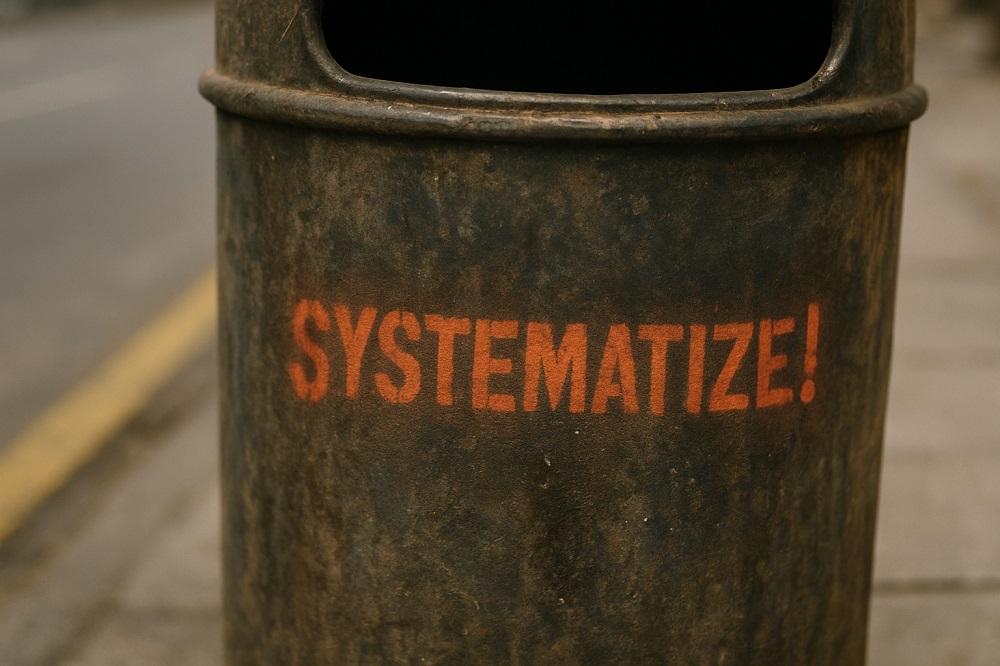
II. Systematize or Vanish
Systematization is too often misunderstood as a mechanical task: a report to fill out, a form to complete, or an obligation to an external funder or institution. In this reduced version, its purpose is compliance. Its audience is bureaucratic. And its result — more often than not — is forgettable.
But that is not what systematization was meant to be.
In Latin America, the concept of "sistematization of experiences" emerged not from administrative offices, but from the pedagogical practices of social movements, popular educators, and grassroots organizations. It was conceived as a way to reflect critically on lived experience, to recover the knowledge embedded in daily practice, and to generate tools for collective transformation. It is closer to ethnographic documentation and action-research than to a final report; closer to praxis than to metrics.
To systematize is to reconstruct a process: what was done, how it unfolded, with whom, in what context, with what tensions, with what outcomes — expected or not. It is to identify the logic beneath the actions, the questions that remained unanswered, the methods that emerged by necessity rather than design. It is, above all, to acknowledge that practice generates knowledge, and that this knowledge deserves to persist.
When we do not systematize, library work becomes disposable. Our collective learning dissipates. New teams reinvent the wheel. Errors are repeated, not because of negligence, but because of silence. What might have become a shared tool remains a private memory — until even that fades.
Systematizing is a form of memory work. It is a narrative infrastructure: a web of experiences, reflections, and lessons that other librarians can access, adapt, and contribute to. It is also a infrastructure of continuity. It turns a singular experience into a point of reference. It creates the conditions for dialogue across institutions, generations, and geographies. It resists the constant erosion of institutional memory caused by turnover, precarious contracts, and shifting political agendas.
Moreover, systematization is not limited to formal spaces. You do not need a platform, a title, or a budget to document what you've lived and learned. A community library working with recycled furniture and volunteer staff can still produce reflections of enormous strategic and epistemic value. A voice note, a field notebook, a simple photo essay can hold more truth than a dozen institutional evaluations.
Systematize not to fulfill a requirement, but to build archives. To write articles. To share insights at conferences. To teach others what worked — and what didn't. To leave breadcrumbs for the librarian who will inherit your space, your challenges, your hopes.
Because if we don't tell our own stories of library practice, no one will. And without those stories, the ecosystem forgets what it already knew.
III. Communicate Without Applause
There is a moment in every librarian's practice — perhaps after a particularly meaningful program, a hard-earned lesson, or a difficult silence — when the impulse to share emerges. Not to promote, but to reflect. Not to seek attention, but to leave something behind. That impulse is not secondary to the work. It is part of it.
Communication, in the context of library ecosystems, must be understood not as publicity or visibility, but as a knowledge practice. It is the act of giving form and voice to what has been learned, so that it can circulate, resonate, and potentially be taken up by others. It is a gesture of generosity — and of responsibility.
In an age saturated with noise, spectacle, and performance metrics, librarians must resist the idea that their communication needs to be instant, constant, or optimized for engagement. What matters is not the velocity or visibility of a message, but its sediment: the trace it leaves in someone else's thought or practice. A line that stays. A question that echoes. A detail that opens perspective.
Not every message needs to be public. Silence, too, is a form of communication — especially in contexts where overexposure can be extractive or unsafe. Knowing when not to speak is part of the ethics of communication. But when one does speak, write, publish, or record, it should be with clarity, intentionality, and commitment to substance.
Communicating well requires slowing down — and even staying two steps behind. It requires articulating experience in language that others can access without simplifying it to the point of cliché. It also means accepting that recognition may not come — and should not be the point. Communication in librarianship is not applause-seeking. It is part of what it means to build a shared epistemic infrastructure.
Be wary of the performative. Choose the compostable over the glittering. Contribute to the commons rather than the trend. Because what Bogotá's libraries need is not more noise. They need meaningful stories that endure, provoke, and connect — even if quietly.
IV. You Don't Have to Be a Writer. But You Do Have to Write
One of the most persistent misconceptions among librarians — especially those working outside of academic or editorial circles — is the belief that documenting experience requires literary skill. That to communicate meaningfully, one must first master "writing" in the formal, published, public sense of the word.
This belief is not only false. It is harmful.
The most insightful contributions to the memory of library work often come not from professional writers, but from professionals who simply take the time — and the risk — to narrate what they've lived. Librarians who sit down, however briefly, and commit their practice to paper: the challenges, the small breakthroughs, the moments of uncertainty, and the hard-earned knowledge that emerges in context.
What matters is not perfect language, but honest articulation. Language that reflects lived experience rather than masking it behind polished institutional prose.
Start modestly. A paragraph a day. A brief reflection at the end of each week. A log of decisions made and why. A description of the atmosphere in a reading club session. A quote from a user. A lesson drawn from failure. Over time, these fragments become a body of knowledge — one that is concrete, cumulative, and eminently useful to others.
Documentation is not just about writing what happened. It's about developing a capacity for self-observation — noticing the how and why of what we do, and translating it into forms others can engage with. This is a habit, not a gift. It develops through repetition, reflection, and a willingness to write without waiting for the perfect words.
Moreover, documentation is not solitary. It benefits from exchange. Share drafts with colleagues. Write collectively. Use voice notes if writing feels distant. Adapt tone to your environment — formal, informal, reflective, descriptive. The point is not to perform, but to preserve.
Because every time a librarian writes down a piece of their process — however partial, however unfinished — they are participating in a broader, deeply needed infrastructure of memory and mutual learning.
And in a context where so much work is temporary, under-recognized, and at risk of disappearance, this kind of writing is not a luxury. It is a form of professional and ethical commitment.
Write because it matters. Write so others don't have to start from scratch. Write so that the ecosystem can recognize itself. Even if your writing is imperfect, inconsistent, or quiet — write. Because silence, in this field, is too often mistaken for absence.
And you are not absent. You are part of the story.
V. From WhatsApp to Journals: A Narrative Continuum
Where should you publish? Wherever you are — and wherever your community is likely to listen, respond, or remember.
Narrative work in librarianship is not linear. It does not begin with prestige or end in academic formality. It begins with presence — with the urgent and practical need to document, to communicate, and to share knowledge where it can do immediate good.
That might mean starting with a WhatsApp voice note sent to a colleague. A Facebook post about a recent program. A hand-distributed flyer summarizing a method. A printed bulletin. A blog entry written in the quiet hours after a long shift. These are not lesser forms — they are first forms, and often the most accessible ones.
From there, narratives grow. A voice note becomes a reflection. A Facebook post becomes a newsletter piece. A blog evolves into a toolkit, a small book, a recorded conversation. That same material, shaped and extended, can later take the form of an article, a conference paper, even a contribution to an academic journal or a national policy recommendation.
The trajectory is not defined by prestige, but by relevance. It is guided by the question: who needs to hear this — and in what format will it reach them?
This is what we call a narrative continuum: a progression of formats, languages, and audiences, each adapted to a different moment, scale, and need. What matters is not where you publish first, but that you begin. That you anchor your story — however modestly — so it can evolve, circulate, and connect.
Importantly, each format carries different epistemic strengths. A flyer may reach a local audience that a journal never will. A tweet may provoke a conversation. A field diary may capture nuance lost in edited texts. Academic publication brings legitimacy in institutional arenas. Each medium has its place, and none should be excluded from the ecology of communication. To do so would not only be exclusionary — it would also be epistemologically narrow and structurally colonial.
To engage this continuum is to practice strategic storytelling. It is to understand that every narrative is a potential seed, and that even the smallest seed can grow into a tree if it is nurtured and allowed to travel.
Let your stories grow. Let them take root in unexpected places. From mud to mountain — what matters is that they live.
VI. A Symbiotic Ecosystem
Bogotá's library ecosystem is not a singular entity. It is a constellation of different institutions, contexts, and voices often operating in parallel, occasionally in tension, and too rarely in coordination.
Some libraries are anchored in universities, supported by stable funding, professional staff, and formal infrastructure. Others operate from neighborhood houses, community centers, or improvised rooms, supported by volunteers and held together by sheer will. Some are built around policy frameworks. Others around necessity.
The differences are real — and should not be denied. But they should also not become barriers.
Systemic collaboration in this city cannot rely on uniformity. It must be built on asymmetrical alliances: partnerships that acknowledge difference, power imbalance, and uneven capacity — and work precisely through them. This requires humility, mutual recognition, and above all, the abandonment of defensiveness and rivalry.
The academic librarian brings tools for system-building, long-term thinking, and structured processes. The community librarian brings situated knowledge, cultural fluency, and proximity to lived realities. The school librarian understands rhythms of pedagogy and curriculum; the mobile librarian understands rhythms of geography and need.
Each holds a different piece of the ecosystem's intelligence. No single piece is complete. What matters is not sameness, but complementarity.
But complementarity requires more than goodwill. It demands a framework: for dialogue, for shared language, for credit and co-authorship, for resource redistribution. Without such a framework, collaboration collapses into tokenism or extractivism. With it, an ecosystem becomes more than a metaphor — it becomes a living structure of interdependence.
Because what Bogotá's libraries need is not a single model, but a mycelial network: decentralized, diverse, resilient.
Together, you make a forest. Alone, you make firewood.
VII. Closing: We Tell to Remain
If we do not narrate what happens in our libraries — the choices we make, the knowledge we generate, the communities we accompany — no one else will. And if others attempt to tell it in our place, they will do so from outside, often without context, often without care.
In the absence of our voices, our work becomes invisible. And what is invisible is eventually erased.
To systematize is to resist that erasure. It is to affirm that library work is not just operational — it is epistemic, cultural, and political. It carries insights worth preserving and transmitting. When we document processes and reflect on them, we build a memory that extends beyond individual contracts, institutions, or administrations.
To communicate is to interrupt silence — not with noise, but with meaning. It is to make experience intelligible and portable. It is to participate in public discourse with dignity and detail, offering grounded stories instead of abstractions or slogans.
To write is to care. Not for prestige, but for continuity. It is to leave a trace that someone else — a new librarian, a policymaker, a teacher, a neighbor — may one day follow. It is to say: "We were here. This was done. This is how it mattered."
To collaborate is to refuse isolation. It is to see the library not as a solitary service point, but as part of a living, complex, and interdependent system. Collaboration ensures that the strength of one space compensates for the vulnerability of another. It is how we weather instability — together.
Because in the end, the future of Bogotá's libraries will not be built solely by new projects or programs. It will be shaped by the narratives we choose to preserve, the relationships we choose to strengthen, and the knowledge we refuse to let disappear.
We tell in order to remain. We write in order to endure. And we remember — collectively — in order to build what comes next.