Home > Blog Cajón de sastre > Conference Spoken Word, Woven Word, Embodied Word
Conference
Spoken Word, Woven Word, Embodied Word
Primera Bienal de la Cultura Escrita Bogotá 2024
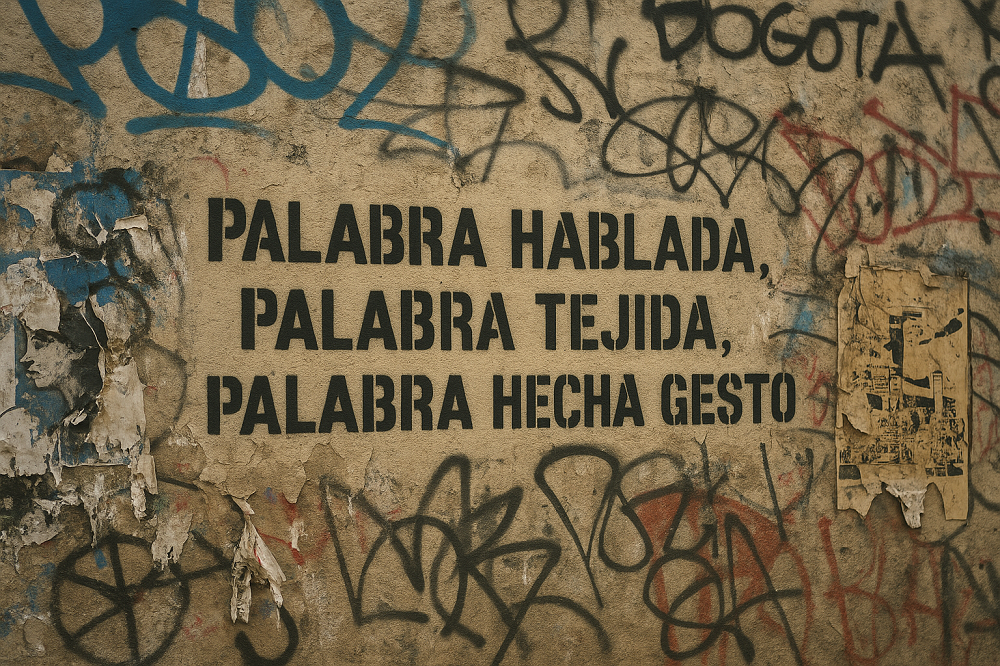
Text presented at the First Biennial of Written Culture (Biblored. Bogota, Colombia, 2024). This conference challenges the hegemony of the written word and argues for libraries and archives that recognize orality, gesture, objects, graffiti, textiles, and territory as legitimate media of knowledge and memory. It exposes the colonial roots of literocetrism (textual supremacy) and calls for decolonial, multisensory, and materially grounded approaches that place diverse forms of knowing on equal footing.
Download the PDF.
Introduction | Part 1 | Part 2 | Part 3 | Part 4 | Part 5 | Conclusion | Postscript #1 | Postscript #2
Introduction. Questioning the Book as a Hegemonic Medium
Why has the book been historically positioned as the preferred — and in many cases, the only legitimate — medium for the preservation and transmission of knowledge and memory? This question, as elementary as it is unpopular in a deeply literate society, unearths and exposes a complex web of power, colonialism, exclusion, and cultural hegemony that must be interrogated.
From ancient times — and with far greater intensity during the (post)colonial period, from the sixteenth century to the present — the book and, more generally, written and/or printed formats have been situated in the popular imagination as the quintessential vehicles for the transmission of knowledge. This process is closely tied to acculturation, identity pressure, forced literacy, and the systematic control of discourse. Literate societies have understood and perpetuated writing — and by extension all its products — as the primary vehicle for constructing knowledge and preserving memory, subordinating, marginalizing, or delegitimizing other equally valid forms and media.
Works by authors such as Walter Mignolo and Boaventura de Sousa Santos suggest that the imposition of the book as hegemonic medium is a central element of the modern colonial project, in which knowledges that do not conform to dominant forms are devalued, made invisible, or directly eliminated. It is no coincidence that this process coincided with the rise of imperialist policies and contemporary nation-states: the standardization of knowledge through the book was part of a broader strategy of cultural colonization.
Literacy was not only a tool of social control but, above all, an ideological and epistemic filter determining which voices were worthy of being heard and remembered, and which should be silenced and forgotten. In this scenario, "other" forms of producing knowledge and transmitting memory — Indigenous oral expressions, the artifacts of rural communities, or the graffiti and embodied practices of peri-urban neighborhoods — were relegated to the margins. The book and writing asserted themselves as symbols of authority and prestige, dismissing peripheral narratives and knowledges.
In (post)colonized spaces, the hard or soft imposition of the book as the preferred medium is a clear exercise of control. And, taking one step further, in certain contexts and historical periods it can be understood as a case of epistemic violence — a category proposed by Gayatri Spivak to describe how mechanisms of power determine which forms of knowledge are legitimized and which are ignored.
From such a perspective, challenging the supremacy of the book means questioning not only a tool but the entire system of values — conscious or unconscious — that underlies and is associated with it.
The hegemony of the book and writing compels us to ask how many sensory, oral, and material memories have been forgotten, dismissed, or rejected, and what kinds of knowledge and memory have been excluded from traditional libraries, archives, and museums. How many paradigms have been left aside, labeled as "other"? And this question invites us to reconsider and evaluate the dominant paradigm upon which knowledge and memory spaces (KMSs) are organized: a model that encompasses everything from the selection policies determining what is deemed worthy of preservation and promotion in a library to the classification systems used in an archive.
The concept of the "pluriverse," explored by Arturo Escobar — the coexistence of multiple forms of knowledge, each with its own epistemological value — may be key to proposing a shift in approach: the inclusion, within KMSs, of multiple paradigms. A library, for instance, that not only preserves printed texts but also hosts voices, sounds, textures, three-dimensional objects, embodied practices, and gestures. Or an archive that not only manages the written but also embraces the sensory and the ephemeral.
Such a transformation would require a necessary decolonization process and would entail the revalorization of non-textual forms of knowledge, historically relegated to the margins of academic "legitimacy." Including "other" formats and media would not only transform the structures and contents of libraries, archives, museums, and related spaces, but also their social function. Objects, gestures, and spoken words are powerful tools of cultural and identity resistance that allow communities — especially marginalized ones — to reclaim their knowledge and memories. The act of recovering and making visible "peripheral" knowledge is not only an act of recognition but a gesture of subversion against a system that has dictated for centuries what must be remembered and what may be forgotten.
Rethinking the management of different knowledge supports — and their respective paradigms — has profound implications. It invites us to imagine alternative futures in which the plurality of voices, bodies, and experiences is not only preserved but allowed to flourish, to be celebrated, and to serve as a tool to transform the world.
Part 1. Orality as the Beginning of Revolt
Orality emerges as the first and most fundamental medium of human knowledge: a tradition older than writing which, despite its antiquity, has been historically delegitimized and marginalized.
In many cultures—especially those subjected to (post)colonial domination—the spoken word has been regarded as a vestige of the "primitive" or the "prehistoric," associated with the ephemeral and the unstable, and therefore dismissed as a valid form for preserving knowledge. Yet orality has been—and continues to be—a powerful source of cultural resistance and an effective way of transmitting knowledge, worldviews, and memories that would otherwise have disappeared.
Anthropologist Walter Ong emphasized that primary orality—occurring in the absence of any written form—creates a collective speech culture in which narratives are built and reinforced through communal interaction and repetition. This stands in contrast to the fixation on writing, which tends to atomize knowledge and allows individuals to appropriate shared knowledge in private, isolated, and independent ways. For many (post)colonized communities, the shift from spoken to written forms marked the imposition of a textual hegemony that not only delegitimized orality but radically transformed how the encoding of knowledge and memory was organized.
From the earliest moments of humanity to the hyper-connected present, oral transmission has been the primary vehicle for sharing narratives. The voice—flexible and accessible—requires neither sophisticated technologies or infrastructures nor specialized training. Yet it is precisely its fluidity, its lack of permanent fixation, that has been used as an argument to devalue it in comparison to the supposed stability and "objectivity" of printed text.
Despite all the disqualifications, orality has endured. Spoken expressions have, in many cases, become refuges for a memory that refuses to be domesticated, challenging structures of power that seek its eradication. Recent research in postcolonial studies has shown how the resurgence of oral forms of protest and cultural recovery has taken place even in contemporary urban contexts: from resistance movements in Latin America to assemblies in marginalized neighborhoods of global cities.
Silencing the spoken word impoverishes the diversity of human memory and, in doing so, undermines the plurality of perspectives and worldviews that allow us to understand the world in richer, more complex ways. In this sense, recovering orality should not be limited to a merely symbolic act—such as the simple creation of audiobook collections or sound archives. A true revalorization necessarily implies reimagining KMSs as spaces in which the paradigm of the spoken word stands on equal footing with that of written text, and in which community dialogue and shared storytelling are central to the construction of knowledge and memory.
Rescuing orality as a legitimate medium is, ultimately, an act of epistemic justice. It is the recognition that knowledge lives not only in what is written but also in voices. Including orality in libraries and archives allows historically marginalized knowledges and memories to coexist and nourish each other, and enables silenced stories to finally find a place where they can be heard.
Part 2. The Gesture as Archive
The human body is, in essence, a living medium of memory: a moving archive that records and transmits knowledge not only through words but also through gestures, postures, and actions. Knowledge and memory are not limited to what is written or spoken; they also inhabit muscles, hair, reflexes, and skin. Each everyday movement — raising a hand, tilting the head — may be imbued with meaning, carrying traces of collective history, values, and the shared experiences of a community.
Throughout history, different societies have inscribed a rich variety of knowledge into the human body. Corporality has served as a vehicle to connect past and present, and as a means of transmitting norms, values, and knowledges into the future. However, Western modernity, with its emphasis on the written and the rational, has dismissed this type of knowledge, relegating it to a secondary role. This perspective has contributed to the invisibilization of "bodily archives": those not found in texts but enduring in the bodies that enact them.
Traditional dances — which in many communities function as genuine cultural records — are not merely artistic expressions; they are also forms of communication carrying histories of resistance, identity, and spirituality. The specific movements of a dance can narrate an entire cosmogony: each gesture or position encloses a relationship with the land and with ancestors. Religious rituals likewise rely on bodily memory. Repeated gestures — crossing oneself, bowing, lifting one's hands to the sky — are infused with centuries of symbolism and devotion. These gestures allow practitioners to partake in a tradition that transcends the individual, linking the present moment with past generations.
Certain hairstyles, scarifications, marks, and tattoos also transmit information. One of the most well-known examples is the maps that enslaved African women in Latin America created in their hair in order to escape toward the freedom of palenques and quilombos. Traditional and modern tattoos and body paintings also speak: about their bearer, their identity, their culture, and their personal and collective history.
But corporality is not limited to a passive archival role: it is also an active agent in the creation and re-creation of knowledge. Practices of bodily resistance — marches, sit-ins, protest dances — demonstrate how moving bodies can inscribe collective memory into dominant narratives, expressing what words cannot reach and recording demands for justice, equality, and dignity. The gesture here is not merely a physical action but a communal expression that challenges structures of power, generating resistant forms of knowledge and memory.
The body and the voice remember what books do not want to. Or cannot: written documents, powerful as they are, do not encompass everything a human being knows or experiences.
If the body is an archive, then all KMSs should open their doors to this type of information: places where the corporeal also belongs, where performances are celebrated, and where people can learn through physical and sensory experience. Spaces that offer opportunities, for instance, for dance and the re-creation of rituals — exploring the body as a medium of knowledge and memory.
This perspective does not imply substituting the written with the bodily, but integrating both in a constant dialogue. In a library or archive that embraces bodily memory, written word, voice, and gesture would intertwine in ongoing interaction, mutually enriching the understanding of knowledge and remembrance. Every book would become a doorway to a bodily interpretation, and every movement, a living reading of that which cannot be captured in words. In such ideal spaces, the bodily and the written are not mutually exclusive: they complement one another.
Part 3. Objects as Memory
Three-dimensional objects have played a fundamental role as media for knowledge and experience that transcend the written, the spoken, and the gestural.
Since time immemorial, human societies have relied on materials such as ceramics, bamboo, wood, bark, metal, or wicker to narrate stories and preserve knowledge that finds no place in the pages of books. These artifacts, although devoid of words, are saturated with meaning. Every fold, every line, every texture acts as an inscription — a material testimony of the hands that created them, of the knowledge transmitted, and of the memories they sustain. Through these objects, we access forms of knowledge deeply rooted in the tangible, which have been historically ignored or delegitimized by dominant epistemic forms.
Traditional societies, for instance, have used the material world as an essential means of preserving and transmitting their histories. Andean textiles, woven with specific colors and patterns, are not merely artistic products (and certainly not "crafts" in the diminutive sense), but archives of identity, markers of lineage, and maps of worldviews connecting communities to their environments, their ancestors, and the natural cycle of life. The same is true of the molas — sewn or embroidered textiles — of the Gunadule people of Panama and Colombia, and the painted textiles of the Shipibo people of Peru. Despite their significance, such materials have been systematically marginalized, relegated to the status of "handicraft" or "curiosity," stripped of their value as legitimate supports for knowledge and memory. (Post)colonialism has exercised its dominion in part through the subjugation of objects and artifacts: anything that failed to conform to Western molds, schemas, or patterns was labeled "primitive" or "inferior," thus denying it legitimacy.
Such marginalization constitutes yet another example of epistemic violence: excluding these artifacts from the dominant canon of knowledge prevents a fuller, more diverse understanding of human knowing.
It is urgent to revalue the materiality of knowledge. Objects are not simply "objects": they possess symbolic, emotional, and cultural weight that makes them capable of narrating stories and transmitting knowledge in ways the written text cannot. And it is not only the artifact itself that communicates, but also its process of creation, its use, and its transformation over time. Each item carries within it the history of those who produced it, the contexts in which it was used, and the meanings it has accumulated over the years.
KMSs have the opportunity to expand their approaches and traditional functions by creating environments where the material also has a place. Incorporating collections of three-dimensional artifacts — from pottery and origami to metal castings or plastic objects — that move beyond mere museological interest opens new pathways for accessing knowledge that has been sidelined by dominant formats. Libraries, in particular, could become centers where history is not only read, but also touched, seen, heard, and felt. Materiality offers a direct connection to collective knowledge and memory.
Moreover, objects have the power to speak for themselves without textual mediation. They are "books one can touch," if we momentarily adopt the colonial habit of comparing every informational element to the book. Clay transformed into ceramic carries within it the history of its place of origin and of the fires that hardened it. And it continues telling the stories of its creators centuries after they have disappeared. Although subject to change and interpretation, these media are no less powerful in their capacity to transmit knowledge.
If such objects were integrated into library or archival collections, traditional hierarchies would be challenged, opening the way toward a more inclusive and holistic understanding of what it means to preserve and transmit knowledge and memory. Three-dimensional artifacts cease to be mere supplements to written text and are recognized as complete archives in their own right: an independent paradigm, with its own logic and its own capacity to tell stories and transmit ideas and discourses.
From this perspective, memory expands beyond text, voice, and gesture to include the tangible. And in this expansion, we recognize that the material world also carries its own narrative — silenced for far too long — and that it deserves to be heard.
Part 4. Graffiti and Textiles: Insurgent Narratives
Although at first glance they may seem like disparate manifestations, graffiti and textiles share a deeply subversive essence. Both are media that challenge — each in its own way — the structures of hegemonic power, standing as vehicles of cultural and identity-based resistance.
Graffiti, on one hand, is the art of the streets: an insurgent form of knowledge that does not ask permission to exist. It emerges from direct action upon public space, transforming walls and surfaces into places saturated with stories, protests, demands, and collective memories. Its ephemeral nature — it can be erased or covered at any moment — makes it a living archive in constant renewal, reflecting the pulse of a community's tensions and social struggles.
Graffiti is immediate and disruptive, and it is saturated with meaning. Each stroke, each word, each image printed on a wall is a declaration of presence and intent, and a demand to be heard. It is a form of knowledge that challenges traditional notions of authorship, legitimacy, and permanence. While books remain within the bounds of the acceptable and the correct, graffiti settles in the physical and symbolic margins of society, claiming spaces that, in theory, do not belong to it. In its rejection of conventions and institutions, it positions itself as a community archive: a rebellious discourse that transforms the urban landscape into a medium through which knowledge and memory are shared without mediation.
Throughout recent history, graffiti has been used as a tool of political resistance in contexts as diverse as the Berlin Wall, the neighborhoods of Johannesburg, or the subway cars of New York. It is not merely a form of art: it is an act of reclamation, a gesture of uprising against the invisibilization of marginalized voices and memories. Graffiti demonstrates that knowledge does not always require formal structures to be transmitted: a wall and a spray can are enough for memory to become inscribed in collective space. Far from being a simple popular expression, it can be a pedagogical tool — a medium that KMSs could consider not only as objects of documentation but also of learning.
If graffiti is the shout, weaving is the whisper — silent but equally powerful. Across centuries, it has served as a subtle way of recording stories and knowledge in the interlacing of threads and patterns which, although not expressed in words, communicate deeply rooted meanings. In many traditional societies, textile work has been a space for memory in which each color, each figure, and each texture carries a specific meaning. Through weaving, communities connect with their history, their beliefs, and their environment through a manual practice intimately tied to body and time.
Despite its importance, textile work has been historically feminized and devalued, relegated to the domestic and "artisanal," and removed from notions of "legitimate" knowledge. Patriarchal and (post)colonial societies have underestimated its capacity as a medium of knowledge, reducing textiles to decorative or utilitarian objects.
But weaving is, in many respects, the archive of the everyday: a material narrative that challenges hegemonic dictates, a form of saying that overflows the limits of written text, a memory inscribed in the warp and weft of threads, a story that unfolds with each knot, a marker of identity, a mode of expressing belonging and resistance, and a path for reclaiming the continuity of traditional histories in a world that has often attempted to erase them.
Textiles have also been political and resistant tools in multiple contexts. From pieces that preserve the histories of Indigenous peoples in Latin America to protest blankets in feminist and anticolonial movements, weaving has been a way of expressing what cannot always be said in words. It is a medium that inevitably records the actions, thoughts, and struggles of those who produce it — a space where the everyday and the subversive meet.
Both graffiti and textiles offer narratives that have been traditionally marginalized but that possess immense value as sources of cultural and political knowledge. Libraries and archives could host collections of textiles not as mere museum pieces or anthropological curiosities, but as legitimate documents that tell real stories. Each one is a testimony of resistance, identity, and memory. Likewise, graffiti could be documented as part of a visual archive of social struggles, recognizing its capacity to encapsulate moments of agitation and change. Walls speak, and KMSs have the possibility of transforming their practices by welcoming these visual media.
Incorporating graffiti and textiles means recognizing that the threads on cloth and the strokes on walls are also ways of telling, resisting, and remembering. Both forms are essential for constructing a collective memory that is diverse, inclusive, and truly representative.
Part 5. The Territory as Document
Understood as both a physical and cultural space, territory has traditionally been underestimated as a legitimate source of knowledge.
In many Indigenous cultures and rural communities, territory is not simply a place to inhabit, but a living archive that stores the memories, histories, and worldviews of those who move through it. Each mountain, river, or tree can be laden with meanings — not only in terms of natural resources, but also as repositories of collective memory. In this sense, territory functions as a three-dimensional, ever-changing document that preserves and transmits knowledge far beyond written or spoken words.
This concept of "territory as archive" challenges hegemonic notions of documentation that prioritize printed texts or written records. Like a book, territory can be "read," interpreted, and understood in multiple ways, depending on the cultural codes possessed by the community. Indigenous peoples of Latin America, for example, have developed complex forms of "reading" the land: geographic features, patterns of flora and fauna, and even climatic cycles are interpreted as indicators of historical events, sacred rituals, or ancestral routes. This knowledge is inscribed in the landscape, preserved in the materiality of territory, and transmitted from generation to generation through everyday practices.
The act of preserving territory (sometimes framed merely as "the environment") is also an act of cultural resistance. Communities that have been dispossessed of their lands — whether through (post)colonial processes, urbanization, or industrial expansion — not only lose physical space but also an essential part of their cultural archive and historical memory. Forced displacement or the destruction of landscape are forms of epistemic violence that strip communities of their ability to preserve and transmit their knowledges. In this sense, the struggle for land is not only a political or economic issue, but also a defense of the living archives embodied by territory.
Moreover, the idea of territory as document is not limited to Indigenous or rural spheres. In urban contexts, public spaces, neighborhoods, and infrastructures also tell stories. Graffiti on walls, the routes followed by migrants, and historical buildings are part of a territory that, though transformed, remains a carrier of collective memory. These urban manifestations remind us that territory is in constant flux: a dynamic element that reflects and records the tensions, struggles, and social transformations of a community.
Revaluing territory as a document implies recognizing the plurality of ways in which knowledge can be inscribed and transmitted. It is a call for libraries, archives, and museums to broaden their understanding of what constitutes knowledge and memory. Including territory as a source of knowing is a way to challenge traditional epistemic hierarchies and open the door to a greater diversity of voices and forms of memory within KMSs.
Conclusion. Redefining the Library: From Words to Action
Throughout this text, the aim has been to challenge traditional conceptions of the library and other KMSs, which tend — due in part to etymology itself — to be understood as repositories of printed texts. In a world in constant transformation, it is urgent to reimagine the library not as a static storage space but as an active one, where sensory, cultural, and political experimentation is encouraged.
It is essential to envision libraries that transcend the boundaries of shelves filled with printed documents and that explore the vast horizon of knowledge forms that are not limited to text. It is crucial to imagine environments where knowledge manifests in a diversity of sensory and experiential forms: walls transformed into graffiti canvases narrating collective stories; rooms vibrating with oral narratives and live music; and spaces overflowing with three-dimensional objects that tell their own stories through their materiality. Such a library not only challenges established knowledge hierarchies but also invites new modes of interaction and understanding, allowing users not merely to consume information but to live it and create it actively.
The library must become a cultural laboratory: a space where creativity and identity-based resistance intertwine, and where every form of memory, from printed word to bodily gesture, has its legitimate and non-subordinated place. The purpose of this new perspective — one that gathers multiple equivalent paradigms — is to transform libraries into places that not only safeguard knowledge but also integrate it in all its richness, diversity, and vitality, grounded in an approach of recognition, value, and respect.
The library of the future will not be simply a repository of books, but a dynamic meeting point: a space of exchange in which plurality is celebrated and connections among diverse ways of knowing and remembering are fostered. In this library, knowledge and memory will be preserved not only through texts, but through materiality, bodies, and human interactions. It will be a cultural space capable of reflecting the complexity of human experience — in its entirety.
Postscript #1. The Weavers of Memory
The "weaving of memories" within KMSs emerges as an optimal methodological proposal for managing and giving coherence to the multiplicity of formats present in libraries, archives, museums, and related spaces.
Faced with the coexistence of written, sonic, visual, material, and bodily media, it becomes necessary to adopt a strategy that can articulate these different forms of knowledge and memory. Weaving knowledges and memories means creating a network of interrelationships among diverse media, recognizing that each one contributes a unique and complementary value, and that it is in their interlacing that a richer and more comprehensive narrative is constructed.
This approach begins with the idea that no form of information can be understood in isolation if one seeks an integral representation of knowledge. Each format must be treated as a "thread" within a broader fabric. Only through integration is it possible to build a documentary system that not only preserves documents, but also promotes their interaction and constant reinterpretation. The weaving of memories thus positions itself as an effective way to manage the epistemic plurality inherent in contemporary collections.
Likewise, this process must be understood as an act of epistemic equity. By intertwining different formats and expressions, it avoids the hierarchy that has historically privileged the written text over other media. Weaving memories means placing oral narratives, three-dimensional objects, and visual or gestural expressions on equal footing, recognizing that all of them are valid and legitimate manifestations. This approach contributes to dismantling the power structures that have perpetuated the exclusion of certain knowledges and communities from the archival and bibliographic canon.
The proposal of weaving memories also carries practical implications for the organization and management of KMSs. Libraries and archives must become spaces where the plurality of media is not only stored, but activated through processes that promote dialogue and interaction among them. In this sense, weaving memories is not merely a matter of preservation, but a strategy for generating new readings and forms of interpretation that enrich access to and understanding of knowledge.
The weaving of memories presents itself as an integral and necessary methodology for the libraries and archives of the future. By articulating different formats into an interconnected network, this proposal enables not only the efficient management of epistemic diversity but also a more just and inclusive representation of the multiple ways of knowing and remembering.
Postscript #2. Decolonizing
The process of decolonizing knowledge and memory is a fundamental challenge that cannot be confined to theoretical or symbolic discourse: it must be an active, conscious, and transformative practice.
This practice begins by questioning the very foundations of what is understood as knowledge: Who holds the power to produce it? Who preserves it? How is it transmitted? And who has been historically excluded from these processes? Decolonization requires a radical shift that transforms KMSs into spaces of cultural, identity-based, and political resistance — spaces in which the written word shares the stage with gesture, with the shout, with art, and with matter.
For this transformation to be effective, libraries and archives must adopt an inclusive and equitable approach to different forms of knowledge. Epistemic justice demands recognizing and valuing those forms of memory that have been historically marginalized or ignored by hegemonic structures of power. This includes oral memories, material objects, gestures, rituals, and all cultural manifestations that do not conform to the dominant paradigm of writing. Libraries must become places of welcome and celebration of epistemological diversity, where each form of expression finds a place to be preserved, appreciated, and transmitted.
Dismantling knowledge hierarchies also implies a reevaluation of archival and bibliographic practices (cataloging, classification, indexing, documentary analysis...). For decolonization to become reality, these practices must be inclusive and representative of the plurality of voices and experiences that inhabit our societies. Through this process, KMSs will not only broaden their understanding of the world, but also strengthen the social and cultural bonds that sustain communities.
By rethinking memory and knowledge through a decolonial lens, libraries and archives can become beacons of inclusion — spaces where information is not only preserved, but lived and experienced in dynamic and meaningful ways.
The challenge is immense, but so is the opportunity. Transforming libraries into places where knowledge manifests in all its complexity and diversity is an ambitious but attainable goal. It is a call to action: to act with courage, with creativity, and with a genuine commitment to building a future in which every form of knowledge has its place in the vast tapestry of human knowing. Only then can it be said that libraries have fulfilled their deepest mission: to be spaces where memory is preserved, but also liberated, shared, and celebrated.