Home > Blog Cajón de sastre > Conference Living Libraries in Latin America
Conference
Living Libraries in Latin America
Encuentro Provincial de Bibliotecas de Cachapoal 2025
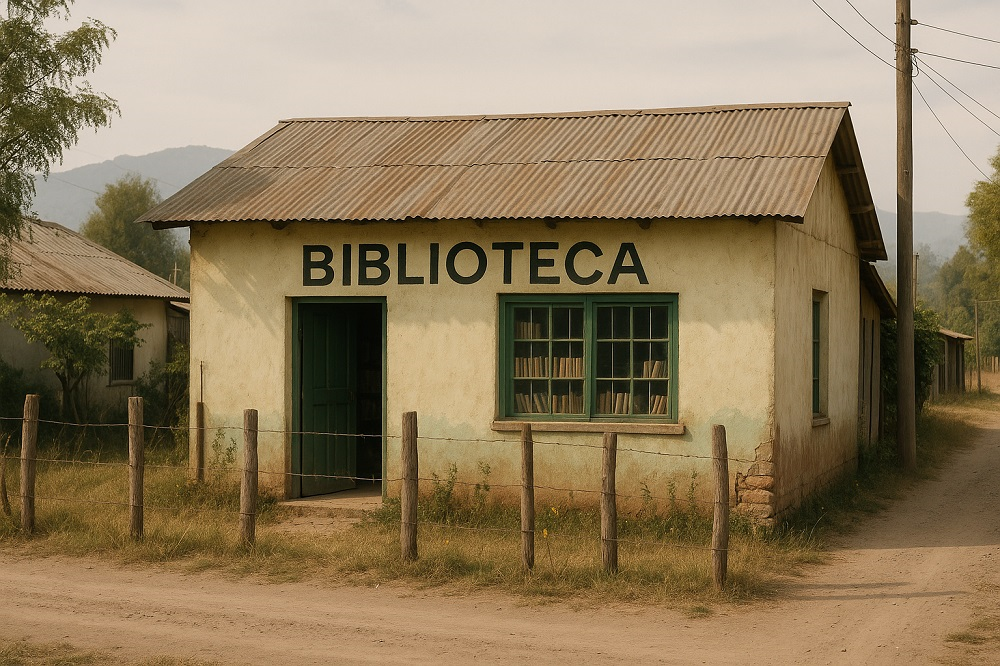
Text presented at the 2025 Cachapoal Provincial Library Meeting (Rancagua, Chile, 2025). This conference reimagines rural libraries as living systems: adaptable, fragile, and deeply rooted in the territories they serve. It analyzes how imported management models clash with local realities, exposing the colonial framework of "modernization" and revealing, instead, a silent and persistent intelligence born of care, improvisation, and ecological interdependence. A journey through the smallest libraries of the Global South, where management becomes translation, structure becomes lifeblood, and survival itself becomes a political act.
Download the PDF.
Introduction | From Critical Librarianship to Epistemic Ecology | Diagnosing the Mismatch | From Management to Mediation | The Epistemic Dimension | Implications for Policy and Professional Practice | Conclusion | References
1. Introduction: The Structural Problem of Library Models
Across much of the Global South, library management frameworks have emerged under the influence of urban modernity, international aid programs, and data-driven governance. These frameworks, built around notions of efficiency, scalability, and standardization, implicitly define “good management” as the faithful implementation of externally designed systems. In practice, they establish an invisible hierarchy between metropolitan centers of knowledge production and rural or peripheral spaces of service delivery.
Rural libraries, particularly in Latin America, operate within this asymmetry. They are charged with delivering modernity to the margins — literacy, connectivity, information — while being structurally excluded from the conditions assumed by their management models: stable funding, professional staff, and reliable infrastructure. The consequence is a persistent epistemic mismatch between design and reality.
Critical librarianship has long warned that libraries are not neutral institutions. They reproduce the social orders that sustain them. Yet much of the critical discourse remains concentrated in academic or urban settings, rarely extending to the small, underfunded rural libraries where structural inequities manifest most sharply. The question, then, is not only how to make libraries more inclusive, but how to make management itself epistemically accountable.
This conference develops that question through a Latin American lens. It examines how imported technocratic paradigms collide with territorial realities; how colonial assumptions persist within policy language; and how librarians — often unconsciously — practice contextual innovation to keep their institutions alive. Finally, it proposes a conceptual and operational framework for rural libraries as living systems: dynamic, adaptive, and rooted in local knowledge ecologies.
2. From Critical Librarianship to Epistemic Ecology
2.1. Critical Librarianship and Structural Reflexivity
Critical librarianship (critlib) emerged as a response to the unexamined neutrality of professional discourse. Scholars such as Pagowsky & McElroy (2016) showed that libraries participate in systemic inequities through labor exploitation, intellectual gatekeeping, and value hierarchies masked as “best practices.” Leckie, Given, & Buschman (2010) argued that LIS must confront its own institutional complicity with neoliberal governance, managerialism, and the uncritical adoption of data-driven paradigms.
These critiques highlight that management systems are never neutral: they encode political and epistemic choices. Evaluation metrics privilege quantifiable outputs; automation systems replicate bias; and professional norms often center middle-class, urban experiences as universal standards of service.
2.2. Epistemic Justice and Situated Knowledge
The concept of epistemic injustice (Fricker 2007) provides a foundation for understanding how certain forms of knowledge are systematically devalued. Santos’s notion of epistemologies of the South (2014) and Mignolo’s call for epistemic disobedience (2011) both point to the same structural dynamic: modern knowledge institutions validate some ways of knowing while rendering others folkloric, anecdotal, or invisible.
Donna Haraway’s idea of situated knowledges (1988) extends this critique by asserting that all knowledge emerges from a position, a body, a geography. For libraries, this implies that “universal” management models erase the very conditions that make knowledge local. To manage information in a place is also to manage its epistemic ecology: the ways knowledge circulates, transforms, and survives.
2.3. Institutional Ecology and Systems Thinking
Ecological and posthuman thinkers such as Bennett (2010), Latour (2017), and Stengers (2015) suggest that institutions, like ecosystems, are assemblages of human and non-human agencies. Their stability depends on feedback loops, not hierarchy. This perspective aligns with what some library theorists have begun to describe as institutional ecology: understanding libraries as dynamic, relational systems embedded in socio-material environments.
When applied to rural contexts, this ecological lens reveals that management cannot be purely administrative. It must account for environmental cycles, community rhythms, material fragility, and the ethics of interdependence. In this sense, library management becomes a practice of care and adaptation rather than control.
3. Diagnosing the Mismatch: Urban Technocracy and Colonial Developmentalism
Library policy and management in Latin America are often guided by two intertwined paradigms: technocracy and developmentalism. Both emerged from mid-20th-century modernization theories that equated progress with urbanization, literacy, and technological adoption (Escobar 1995).
Technocratic management defines efficiency as standardization: unified cataloguing, central procurement, unified reporting systems. These tools serve coordination but also establish dependence on centralized infrastructures that rural libraries cannot maintain. Reports, metrics, and performance indicators often measure compliance with an urban model, not relevance to the community.
Developmentalism adds a moral layer: the assumption that rural spaces must be “brought up to date.” This continues the colonial narrative of salvation through knowledge. Under this lens, libraries become instruments of civilization, their success measured by how well they approximate urban ideals — internet connectivity, modern furniture, official language holdings — rather than how effectively they sustain local cultural life.
In Chile, as in many Latin American countries, the National System of Public Libraries (SNBP) has achieved remarkable expansion, but its policy logic remains top-down. Training, evaluation, and resource allocation are largely standardized, with limited mechanisms for contextual adaptation. Librarians are treated as implementers rather than interpreters of policy. This managerial centralization generates what Santos (2014) calls an abyssal line: an invisible division between those who design knowledge systems and those who must inhabit them under unequal conditions.
The result is not merely operational inefficiency, but epistemic extraction: communities are invited to contribute local culture — stories, crafts, traditions — as heritage, while their epistemic authority to shape the library’s management logic remains unacknowledged.
4. From Management to Mediation: The Library as a Living System
Against this backdrop, a more appropriate framework for rural librarianship would treat the library not as an instrument of delivery but as a mediating organism: a living system embedded in its territory. This model borrows both from ecological theory and from practices observed among rural librarians who adapt, improvise, and co-create with their communities despite structural constraints.
4.1. Four Core Functions of a Living Library
- Communication: Maintaining continuous dialogue with users and partners. This is not mere outreach, but the “respiration” of the institution — what Latour (2017) might call circulatory reference. Feedback mechanisms must be informal and constant, not periodic audits.
- Circulation: Facilitating the movement of materials, stories, and people. Rural librarians often build personal delivery networks — by bicycle, radio, or WhatsApp — that extend access beyond infrastructure. These flows are lifelines of institutional vitality.
- Regeneration: Investing in care, repair, and learning. A library that documents its processes, trains its staff, and maintains physical spaces sustainably builds resilience. Regeneration is the library’s metabolism.
- Adaptation: Adjusting to changing conditions — climate, migration, policy. Adaptive capacity distinguishes living systems from mechanical ones. It requires professional autonomy: the right to interpret policy through local judgment.
These four functions form an alternative metric of success: not growth, but vitality. They allow librarians to articulate their work as systems management rather than charity.
4.2. Management as Contextual Translation
In this framework, librarians are not policy executors but translators — mediating between institutional norms and local logics. Their task is not to reject regulation but to contextualize it intelligently, a process similar to what Stengers (2015) calls cosmopolitical diplomacy: negotiating coexistence between heterogeneous worlds.
Contextual management therefore operates as a hybrid practice: one eye on accountability, the other on coherence with lived reality. It values adaptability over uniformity, and relational trust over procedural compliance.
4.3. Ethics of Care as Operational Principle
Tronto’s (2013) ethic of care offers an additional dimension. In fragile systems, sustainability depends on attentiveness, responsiveness, and mutual responsibility. Rural librarianship exemplifies this ethic: caring for people, for collections, for spaces, and for the continuity of knowledge.
To manage through care is not sentimentality — it is a technical strategy for resilience. It recognizes that continuity is maintained not by resources alone but by attention to fragility.
5. The Epistemic Dimension: Rural Libraries and Knowledge Pluralism
Rural libraries are not only service centers; they are epistemic institutions that define what counts as knowledge. By privileging written, catalogued, and globally indexed materials, conventional library science perpetuates epistemic monolingualism.
Following Santos (2014), this can be described as an epistemicide: the systematic invisibilization of subaltern knowledges. Libraries that treat oral, local, or tacit knowledge as mere folklore replicate that dynamic, even unintentionally.
To counter this, a pluralist epistemology of librarianship would recognize multiple forms of literacy and documentation. Community archives and participatory documentation projects demonstrate how local epistemologies can coexist with institutional protocols. The challenge is not technical but political: creating frameworks flexible enough to validate diverse knowledge systems.
In practice, this might mean cataloguing a seed collection alongside books on botany; treating a farmer’s notebook as a document of scientific observation; or storing oral histories as metadata-rich, citable resources. Each act expands the library’s ontology of what counts as information.
The implication is profound: managing a rural library is managing epistemic diversity. It requires both technical skill and political humility — the willingness to let other forms of knowing inhabit the institution without being translated into urban epistemic codes.
6. Implications for Policy and Professional Practice
Implementing this shift demands structural change at three levels:
- Policy: National systems should move from uniform regulation toward contextual frameworks. Guidelines must define principles, not procedures. Evaluation should include qualitative indicators — community trust, continuity, adaptability — alongside quantitative metrics.
- Training: Professional education must include rural epistemologies, community engagement, and systems thinking. Librarians should be trained as mediators and designers, not only as custodians or service operators.
- Research: LIS research in Latin America remains highly centralized. Decentralizing inquiry — funding small-scale studies led by rural librarians themselves — would diversify perspectives and democratize knowledge production.
This is not a rejection of institutional structure but an argument for institutional reflexivity — the ability of systems to learn from their margins. As Haraway (2016) reminded us, “staying with the trouble” means inhabiting complexity without rushing to simplification. Rural librarianship embodies that principle daily.
7. Conclusion: An Ecology of Professional Responsibility
Rural libraries operate at the intersection of infrastructure and imagination. They make the public sphere tangible in places where the State is often an abstraction. However, they generally do so through improvisation, adaptation, and affective labor that policy rarely acknowledges.
A critical approach to management must therefore begin with recognition — not as moral praise, but as analytical correction. These libraries are not underdeveloped versions of urban ones; they are alternative models of institutional intelligence, born of constraint and sustained by care.
Reframing them as living systems restores agency to librarians, epistemic dignity to their communities, and theoretical depth to the profession. It invites us to replace the fantasy of modernization with a more grounded horizon: continuity with dignity, flexibility with coherence, and structure with attentiveness.
The challenge for librarianship — in Latin America and beyond — is not only to modernize systems, but to make them capable of listening.
References
- Bennett, Jane (2010). Vibrant matter: A political ecology of things. Durham and London: Duke University Press.
- Escobar, Arturo (1995). Encountering development: The making and unmaking of the Third World. Princeton: Princeton University Press.
- Fricker, Miranda (2007). Epistemic injustice: Power and the ethics of knowing. Oxford: Oxford University Press.
- Haraway, Donna (1988). Situated knowledges: The science question in feminism and the privilege of partial perspective. Feminist Studies, 14 (3), 575–599.
- Haraway, Donna (2016). Staying with the trouble: Making kin in the Chthulucene. Durham: Duke University Press.
- Latour, Bruno (2017). Facing Gaia: Eight lectures on the new climatic regime. Cambridge: Polity Press.
- Leckie, Gloria, Given, Lisa M. & Buschman, John E. (eds.) (2010). Critical theory for library and information science: Exploring the social from across the disciplines. Santa Barbara: ABC-CLIO.
- Mignolo, Walter D. (2011). The darker side of Western modernity: Global futures, decolonial options. Durham and London: Duke University Press.
- Pagowsky, Nicole & McElroy, Kelly (eds.). (2016). Critical library pedagogy handbook (vols. 1 & 2). Chicago: Association of College and Research Libraries.
- Santos, Boaventura de Sousa (2014). Epistemologies of the South: Justice against epistemicide. London and New York: Routledge.
- Stengers, Isabelle (2015). In catastrophic times: Resisting the coming barbarism. Open Humanities Press.
- Tronto, Joan (2013). Caring democracy: Markets, equality, and justice. New York and London: New York University Press.