Home > Blog The Log of a Librarian > The Shape of Memory (10)
The Shape of Memory (10)
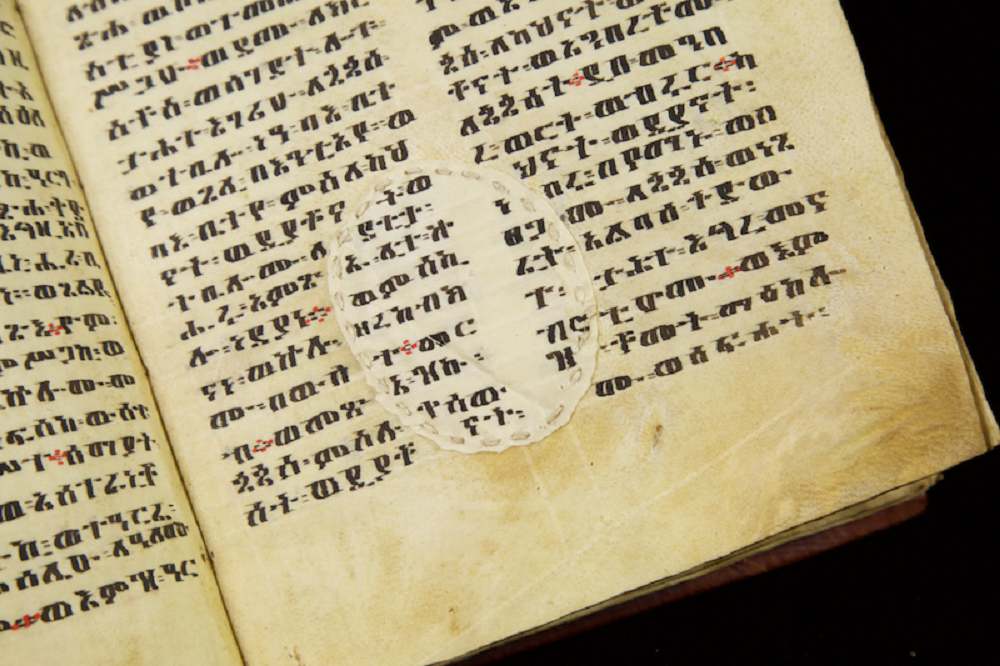
A Hole Older Than the Words
Ethiopian Parchment, Bookbinding, and the Making of Manuscripts
This post is part of a series that explores the many ways human societies have stored, transmitted, and transformed memory across time, beyond the narrow histories centered on books and writing. It approaches archives, documents, and memory systems as historically situated technologies shaped by power, ecology, material conditions, and cultural worldviews, while examining forms of transmission often excluded from dominant narratives of literacy and preservation: oral traditions, woven patterns, musical structures, ritual performances, landscapes, bodies, and other living infrastructures of memory. Check all the posts in this section's index.
The Hole in the Page
In a sixteenth-century Ethiopian Psalter preserved at the Institute of Ethiopian Studies in Addis Ababa, a hole interrupts the writing on folio 46r. The scribe wrote around the opening, leaving parts of the text on either side of the missing parchment.
The hole was already there when the words were written.
Shimels Ayele Yalew and his colleagues documented this example in a 2025 study of the material history of Ethiopic manuscripts. They identified a similar case in a manuscript of homilies preserved at Däbrä Maryam Monastery on Lake Tana, where a scribe divided a word between the two sides of an opening in the parchment. Other manuscripts contain small holes left untouched, larger openings repaired with stitches, and damaged areas reinforced with additional pieces of skin.
These features belong to the production history of the books. A parchment leaf did not necessarily need to be perfect before it could receive a text. An opening could be avoided, stitched, patched, or accommodated within the written page.
The surviving manuscripts allow us to investigate how Ethiopian bookmakers worked with the materials available to them. Their bindings, writing surfaces, repairs, and other physical features preserve information that cannot be recovered from the written contents alone.
Making a Writing Surface
Parchment is prepared from animal skin, usually by cleaning, scraping, stretching, and drying it under tension. Unlike ordinary leather, it is not tanned to produce a soft, flexible material. The preparation creates a surface suitable for writing, but the resulting leaves retain differences in thickness, texture, and appearance.
Animal skins can also contain imperfections. Injuries sustained before slaughter, cuts made during skinning, and damage caused by scraping or stretching may produce holes. Some are small enough to leave untouched. Others require intervention if the surrounding material is to remain usable.
Yalew and his colleagues documented several methods of repairing Ethiopian parchment manuscripts. Some openings were closed with running stitches; others received zigzag stitching or additional pieces of parchment. A genealogical manuscript preserved at the Institute of Ethiopian Studies contains a particularly conspicuous zigzag repair on folio 134.
The stitching could be completed before writing, as part of preparing the leaf. Similar repairs could also be made later, after a manuscript had been used or damaged. Their chronology must be established from the physical evidence, including the relationship between the thread, the parchment, and the writing.
In the case of the Psalter, catalogued as IES MS 76, the arrangement of the words shows that the hole preceded the text. The scribe did not attempt to conceal the opening. He accommodated it.
Such material decisions become easier to understand when we examine Ethiopian parchment-making practices documented in recent times.
In July 2022, Amanuel Abrha and Hagos Gebremariam conducted fieldwork among the scribes of Ləggat, a village in eastern Tigray, in collaboration with Denis Nosnitsin of the University of Hamburg. Their report describes a community whose members possessed the skills necessary to prepare parchment, manufacture writing instruments, copy manuscripts, and bind books.
The scribes used the skins of goats, sheep, and cattle. Goatskin was generally preferred for its quality, while cattle skins were useful for larger books and for making protective cases. Skins were stretched on frames and worked with scraping instruments. The researchers documented the frames themselves, the iron rods used to hold the skins, and specialized tools for treating their different surfaces.
Not every scribe prepared all his materials. Some purchased parchment from suppliers, although they knew how it was made.
The practices recorded at Ləggat offer a close view of the work involved in producing the kind of writing surface found in historical Ethiopian codices. They do not establish that every procedure was identical centuries earlier, but they make the material and technical decisions involved much more intelligible.
Sewing the Book
Once prepared, parchment leaves had to be organized into a book.
Most surviving Ethiopic manuscripts are codices made from folded parchment sheets arranged in gatherings, or quires. A sheet folded in half produces two leaves and four pages. Several folded sheets can be nested together, and the resulting gatherings joined to form a larger volume.
Traditional Ethiopian binding employs a distinctive linked sewing structure, commonly called chain stitching. The thread passes through the folds of the gatherings, connecting them along the spine. In characteristic examples, the wooden cover boards are attached through the same sewing system that holds the gatherings together.
The structure differs from many European binding methods in which gatherings are sewn onto separate supports, subsequently attached to the covers. Ethiopian bookmakers developed practical solutions for joining parchment leaves and wooden boards into a functional codex without such supports.
A surviving example is manuscript W.850 at the Walters Art Museum in Baltimore. Produced during the first half of the sixteenth century and associated with the monastery of Gunda Gunde in northern Ethiopia, it contains the four Gospels in Gəʿəz, the traditional liturgical language of the Ethiopian Orthodox Church.
The manuscript is extensively illustrated, with eleven full-page miniatures, six canon tables, and elaborate decorative headpieces. Its original binding also survives. The book has wooden boards attached through chain stitching at six sewing stations. Both boards are broken and have been stitched together. Remains of leather survive on the upper cover.
Its present structure therefore preserves evidence of both manufacture and repair. The original sewing tells us how the manuscript was assembled; the stitched boards indicate subsequent physical intervention, although the available catalogue description does not establish when those repairs were made.
Another Ethiopian Gospel manuscript at the Walters, W.836, was copied in the early fourteenth century by a scribe named Mäṭre Krəstos. It also has wooden boards and chain stitching, but its binding is not original. The present covers and sewing cannot be assumed to reproduce precisely the construction of the book when its text was copied.
These two manuscripts illustrate a recurring difficulty in book history. A surviving manuscript may contain materials produced at different moments. Its pages, stitching, covers, and repairs can belong to separate stages in the life of the object.
The distinction is particularly relevant when comparing historical codices with more recent examples of Ethiopian bookbinding. Similar techniques may appear in objects separated by centuries, but the physical history of each manuscript must still be established individually.
Pens, Ink, and the Work of Copying
The scribes of Ləggat also provide unusually detailed evidence about writing practices.
Their pens were made from locally available reeds. A scribe collected the stems, dried them, cut them into sections, and shaped their ends with a sharp knife. Different pens were used for black and red writing.
The black ink was prepared from local ingredients. The researchers recorded a procedure involving roasted barley, water, powdered plant leaves, and a resin used as a binding agent. The resulting mixture could be kept in a partially dried form, with small quantities prepared for writing as needed.
The red ink followed another trajectory. Mäbrahtom Dərar, one of the scribes interviewed, explained that his grandfather had known how to prepare red ink from local plants, but he no longer remembered the ingredients or methods. By the time of the fieldwork, the scribes were purchasing industrially produced red ink from nearby markets, sometimes adding locally obtained resin to modify its properties.
The knowledge required to make books was therefore not transmitted unchanged in every detail. Some methods remained familiar; others were altered or replaced as materials became available through different channels.
The copying itself was demanding. According to the Ləggat report, scribes typically produced between three and six medium-sized pages per day, working for eight or nine hours when necessary. They checked their texts after copying, corrected omissions, and removed mistakes by scraping the parchment before writing the corrected letters or words.
The parchment permitted such interventions. Unlike ink on many modern paper surfaces, writing on parchment could sometimes be carefully scraped away, allowing a scribe to correct a mistake without discarding the entire leaf.
The book emerged through repeated acts of preparation, writing, checking, correction, and assembly.
The Scribes of Ləggat
The existence of this tradition in the twenty-first century is one of the most remarkable aspects of Ethiopian book history.
Ləggat's manuscript-making community traces its local origins to the nineteenth century. According to accounts collected by the researchers, a man named Wäldäqirqos learned the scribal craft in Aksum during the reign of Emperor Yohannes IV (1872–1889) and subsequently established a centre for teaching manuscript production in his home village.
The work passed between teachers, pupils, and family members.
During a field visit in March 2019, Denis Nosnitsin met the priest Mäbrahtom Dərar Wäldäqirqos and observed him at work. Mäbrahtom had begun learning the profession from his father when he was ten years old. By twenty, he had become an accomplished scribe.
He reported having copied at least one hundred manuscripts and possessed additional skills in painting miniatures and ornamental decorations. The researchers photographed him copying a manuscript of the Miracles of Mary for the church of Säglat Maryam. His exemplar was a manuscript dated 1963 that had belonged to his father, Dərar Wäldäqirqos.
One photograph shows Mäbrahtom writing with the gathering resting on his lap. Another captures him looking at the exemplar. In a third, he is dipping his pen for red writing into an ink container while holding the pen for black ink between his teeth. These images preserve details of the craft that surviving medieval manuscripts rarely disclose: the position of the body, the management of tools, the relation between exemplar and copy, and the small adjustments made during the work.
In July 2022, researchers documented eleven scribes belonging to the Association of Ləggat Scribes. The village also maintained a school where boys learned the profession. Some apprentices were taught by their fathers; others learned from established scribes in the community. Most combined manuscript production with farming and church service. They worked on commission rather than producing books for a general market, and their customers included Ethiopian churches and communities abroad.
The manuscripts they produced belonged to an active religious and documentary culture. Parchment books were still being requested, copied, illustrated, bound, and used long after printed editions had become available.
A Tradition Interrupted
The fieldwork also recorded the consequences of the war in Tigray. According to the scribes interviewed, their materials were looted or destroyed by Eritrean troops between November 2020 and June 2021. The church of Ləggat Qirqos and its manuscript library were also looted and badly damaged. Commissions ceased for months, depriving the scribes of income from their work.
Some practitioners left the village. Two prominent members of the community died in December 2022, one following a shortage of medical assistance and the other in an accident.
The remaining scribes hoped to resume production and teaching. Discussions included the possibility of copying replacement manuscripts for churches whose books had been burned or stolen. The published report does not establish whether those plans were eventually carried out.
The disruption affected more than the manuscripts already held in the village's library. It damaged the circumstances under which new books could be produced: the availability of materials, the work of experienced craftspeople, relationships with commissioners, and opportunities for training.
The loss of books and the interruption of bookmaking are related, but they are not the same event.
The Marks of Making
The manuscript makers of Ləggat and the historical Ethiopian codices preserved in libraries and museums provide different kinds of evidence.
The surviving manuscripts reveal physical structures, repairs, and traces of work undertaken centuries ago. The field documentation records tools, techniques, professional relationships, and activities that are difficult to reconstruct from the finished objects. Neither source can fully replace the other.
The wooden covers of a sixteenth-century Gospel book preserve evidence of a particular binding structure. A photographed scribe holding one pen between his teeth while using another reveals a detail of the writing process. An apprentice learning from his father shows one way in which the skills necessary to make books could pass between generations. And the hole in the Psalter at the Institute of Ethiopian Studies records a decision made before the manuscript was finished.
Someone prepared a piece of parchment that contained an opening. Someone wrote around it. The leaf was incorporated into a book that survived for centuries.
The words can be transcribed, translated, and reproduced without that opening. But the original page preserves evidence of the physical work through which they came to be written.
Bibliography
- Amanuel Abrha, Hagos Gebremariam, and Denis Nosnitsin (2024). "Book-making Tradition at Ləggat, Gulo Mäkäda District." In After Ethio-SPaRe: Beta maṣāḥəft Field Research, Part 2. Hamburg: University of Hamburg.
- Eagan, Jane. Bookbindings at Keble College: A Book Conservator's Vade Mecum. Oxford: Keble College.
- University of Hamburg. Codicology.
- Walters Art Museum. Ethiopian Gospels, manuscript W.850 (sixteenth century) and manuscript W.836 (fourteenth century). Baltimore.
- Yalew, Shimels Ayele, Natalia Ortega Saez, Tim De Kock, Tigab Bezie Biks, Blen Taye, Ayenew Sileshi Demssie, and Abebe Dires Dinberu (2025). "Material History of Ethiopic Manuscripts: Original Repair, Damage, and Anthropogenic Impact." Arts, 14 (6), 173.