Home > Blog The Log of a Librarian > The Shape of Memory (06)
The Shape of Memory (06)
The Poem Written on Bamboo
Ambahan, Surat Mangyan, and the Social Life of Writing
This post is part of a series that explores the many ways human societies have stored, transmitted, and transformed memory across time, beyond the narrow histories centered on books and writing. It approaches archives, documents, and memory systems as historically situated technologies shaped by power, ecology, material conditions, and cultural worldviews, while examining forms of transmission often excluded from dominant narratives of literacy and preservation: oral traditions, woven patterns, musical structures, ritual performances, landscapes, bodies, and other living infrastructures of memory. Check all the posts in this section's index.
A Written Poem Without a Page
Histories of writing tend to follow objects that were made to survive: stone inscriptions, clay tablets, manuscripts, printed books, and the papers accumulated by states and institutions. Their materials differ, but they share a familiar documentary ambition. Words are separated from the moment of speech and placed on a support that can carry them elsewhere.
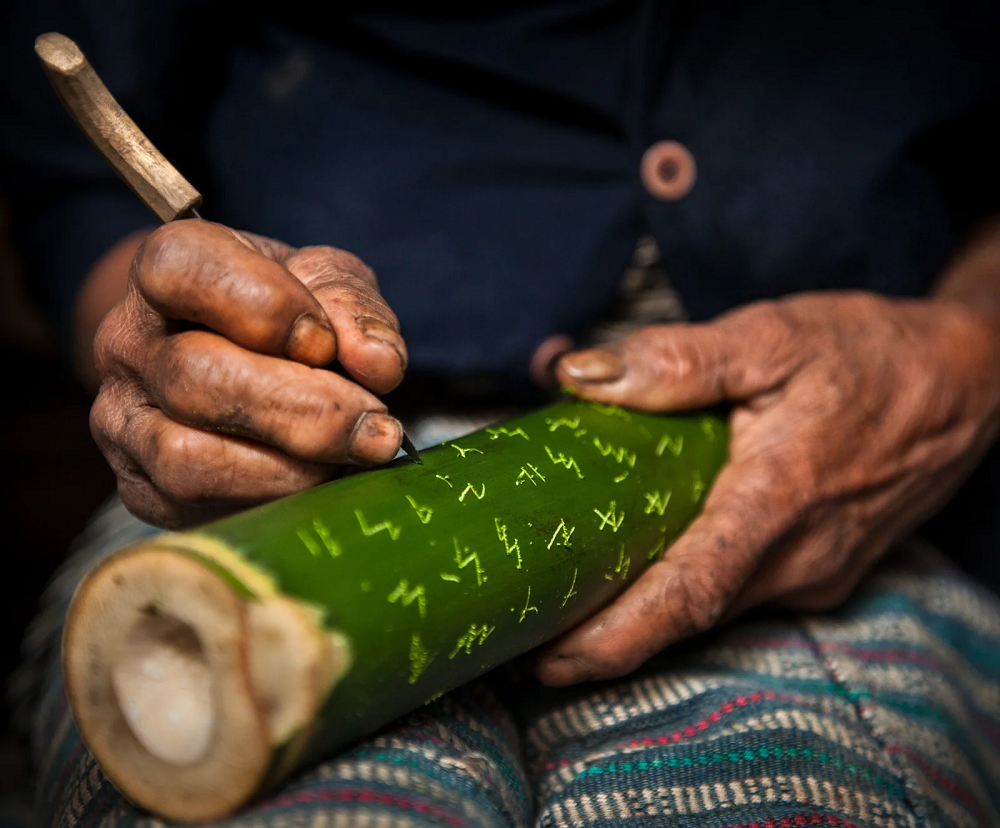
Among the Hanunóo Mangyan of southern Mindoro, in the Philippines, writing has long occupied a different material world. Characters are incised with a knife into sections of bamboo, tobacco containers, lime holders, musical instruments, house posts, and other wooden surfaces. In some accounts, inscriptions also appear on standing bamboo along paths. The written surface may therefore be a personal possession, a gift, an implement, part of a dwelling, or a plant encountered while moving through the landscape.
One of the forms carried by these surfaces is the ambahan, a poetic expression composed in lines of seven syllables and transmitted through recitation, inscription, memory, and social use. The bamboo makes the poem visible, but it does not detach it completely from voice or circumstance. An inscription may preserve words while leaving much of their meaning dependent on vocabulary, rhythm, context, and knowledge held by the reader.
The result is neither an oral tradition that happens occasionally to be written nor a written literature whose spoken performance is secondary. Ambahan moves between the two. Its documentary life emerges through their conjunction.
Mindoro and the Name Mangyan
Mangyan is commonly used as a collective designation for several Indigenous peoples of Mindoro, including the Iraya, Alangan, Tadyawan, Tawbuid, Bangon, Buhid, Hanunóo, and Ratagnon. The term should not obscure their differences. These communities speak distinct languages and possess different histories and cultural practices. Among them, the Hanunóo and Buhid of southern Mindoro have attested Indigenous writing systems, each with its own forms.
This essay concerns the Hanunóo tradition and the script often called Surat Mangyan or Surat Hanunóo Mangyan. The name Hanunóo itself is an external designation frequently combined with Mangyan in scholarly and institutional writing. Within their own communities, people may refer to themselves and their language simply as Mangyan.
The script belongs to the family of Indic-derived writing systems once used more widely across the Philippine archipelago. Spanish colonization and the spread of the Latin alphabet displaced most of those systems. Hanunóo and Buhid writing in Mindoro, together with the Tagbanua and Pala'wan traditions of Palawan, remained in use. Their persistence is often described as survival, but the word can make continuity sound passive. Scripts endure because people continue to learn, adapt, inscribe, read, recite, and find uses for them.
Ambahan provided one of those uses. Writing was sustained within a poetic and social practice rather than reserved for government, commerce, or institutional religion.
Seven Syllables
Antoon Postma, drawing partly on Harold Conklin's linguistic work and on his own long study of Hanunóo Mangyan poetry, described ambahan through a group of recurring characteristics. Its lines generally contain seven syllables. Their endings rhyme. The poem is chanted or nearly recited, without a fixed melodic pitch and ordinarily without instrumental accompaniment. Its language includes a specialized vocabulary not commonly heard in everyday conversation, and it often uses images drawn from plants, animals, weather, water, travel, and landscape to speak indirectly about human situations.
The seven-syllable line is a strong rule, though not an absolute one. Some introductory expressions fall outside the count, and exceptional lines may be longer or shorter when wording and meaning require it. More often, the meter shapes the language. Words may be contracted, extended, or adjusted to fit the line. A listener who understands ordinary Hanunóo speech may therefore still find ambahan difficult.
Its images do not carry one universal interpretation. A warning about obtaining honey without being stung can speak to travel, competition, courtship, or another risky undertaking according to the occasion. The poem gains precision from the encounter between a known repertoire and a present circumstance.
Ambahan is used in social life. Parents may address children through it. Young people may exchange verses in courtship. A visitor may ask for food or hospitality. Someone leaving may offer a farewell. Friends and relatives may communicate affection, uncertainty, advice, refusal, or remembrance. The poem provides a disciplined form through which something difficult, delicate, or potentially confrontational can be said indirectly.
This social use complicates the modern expectation that a poem originates as the private creation of a named author and subsequently reaches an audience. Ambahan can circulate as a repertoire. A person recalls a verse, selects it for an occasion, adjusts its force through delivery, and directs it toward someone who understands both the form and the situation. Composition, memory, performance, and reuse may overlap.
Many collected ambahan have reached archives without a recoverable individual composer. That should not turn Hanunóo poetry into anonymous folklore by definition. Historical collections preserve the names of Mangyan writers such as Kabal, Luyon, and Balik, while Ginaw Bilog became nationally recognized for his command and preservation of ambahan. The difficulty lies in respecting both forms of continuity: poems carried through collective circulation and poems associated with identifiable writers and custodians.
A Script That Requires a Reader
Surat Mangyan is a syllabic writing system. A consonantal character ordinarily includes an inherent vowel, while small marks known as kudlit modify that vowel. The traditional system does not consistently represent consonants at the ends of syllables, and it does not separate every word with spaces. The same written sequence may therefore permit several possible readings.
These features do not make the script incomplete. They locate part of reading outside the visible marks. A competent reader supplies likely consonants, identifies word boundaries, recognizes poetic vocabulary, and tests each possibility against meter, rhyme, grammar, and meaning. Ambahan adds another layer because its contractions, extensions, and specialized words differ from ordinary speech.
Ramón Guillermo's recent work on computer-assisted reading makes this structure unusually visible. A program can generate possible word divisions and readings from a transliterated sequence, but the output still requires linguistic and cultural judgment. Computation can expose alternatives; it cannot decide the poem by itself. The inscription is legible through a field of relations that includes script knowledge, vocabulary, poetic form, occasion, and interpretation.
Surat Mangyan has also changed. Antoon Postma proposed a pamudpod, or vowel-cancelling sign, to represent final consonants more explicitly. Later primers incorporated it into formal teaching, and community consultations considered which character forms should be used in schools. These interventions reveal a living script responding to new settings. Once writing moves from household and community transmission into classrooms, printed primers, heritage programs, Unicode fonts, and computer-assisted tools, questions of standardization become unavoidable.
A standardized form may make instruction easier and extend the script into new media. It can also privilege one graphic solution over the variations practiced by different writers. Preservation here involves decisions about how much a script may change while remaining recognizable to those who inherit it.
The Knife and the Bamboo
Bamboo gives Surat Mangyan part of its visible character. Letters are cut into a resistant curved surface with a pointed knife. The movement differs from writing with ink across paper. The writer holds, rotates, and steadies the object while directing the blade through its outer skin. Characters are commonly arranged in columns and inscribed away from the writer's body. Their angularity has been associated with the demands of incision.
The object being written upon may already have a practical life. Bamboo tubes serve as containers for tobacco leaves, lime used with betel, and other small possessions. During courtship, a man may decorate and inscribe a container before offering it to a woman. She can answer by writing on the same tube and returning it during a later exchange. The surface accumulates relation as well as language.
Such an object is difficult to place within the familiar distinction between document and artifact. It carries a text, but it may also hold a substance, pass from hand to hand, display ornament, and participate in a courtship sequence. Its meaning lies partly in what is written and partly in who prepared, offered, received, answered, and kept it.
Bamboo also imposes a particular temporality. In the tropical climate of Mindoro, it deteriorates. Few old inscriptions remain in comparison with the probable scale of past writing. The physical record is shallow even when the practice has deeper roots. The scarcity of early examples does not demonstrate that the script was rarely used, but how little its customary support was suited to becoming archaeological or archival evidence.
Yet perishability does not make every inscription intentionally ephemeral. A bamboo object can be valued, carried, and kept. Ginaw Bilog maintained ambahan inherited from his father and grandfather and recorded poems both on bamboo and in notebooks. What bamboo changes is the guarantee of survival. Continuity cannot depend on one inscribed object remaining intact indefinitely. It also requires recollection, recitation, copying, repeated writing, and the continued ability to read.
Writing as Social Memory
The relation between inscription and memory becomes clearer when ambahan is learned. Hanunóo children encounter the script through parents, observation, imitation, and repeated practice on bamboo, wood, and leaves. Writing helps a learner retain verses, but the poem is not completed by silent decoding. It must also be understood as language and used in an appropriate social setting.
The bamboo inscription can operate as a memory support, a personal message, an exercise, or a durable stage within a spoken exchange. These functions are not mutually exclusive. A verse sent during courtship may be read, remembered, recited, and answered. Its written form allows it to travel between people; its poetic form allows it to remain in memory after the object has been returned, damaged, or lost.
This interaction explains why ambahan cannot be assigned neatly to either orality or literacy. Voice and inscription reinforce one another. The strict line length and rhyme assist recall. The script places a version of the poem outside the body. The occasion guides interpretation. Repetition allows a verse to circulate beyond the life of one bamboo surface.
The documentary unit is consequently larger than the inscription. It includes the writer's hand, the reader's competence, the sounding of the poem, the occasion that activates it, and the relationships through which it continues to be known.
From Bamboo Object to Manuscript
The historical inscriptions that survive in museums and libraries underwent another transformation. In 1894, A. Schadenberg collected inscribed bamboo tubes in Mindoro that were later deposited in Dresden. During the early twentieth century, Fletcher Gardner, a contract surgeon with the United States Army, assembled further examples. Some entered the Newberry Library, while another group eventually reached the Library of Congress.
The Library of Congress collection contains seventy-one bamboo slats and six cylinders assembled between 1904 and 1939. Its production depended on Gardner's collaboration with the brothers Ildefonso and Eusebio Maliwanag, who contributed to transcription and translation. Much of the writing was produced by three Mangyan authors: Luyon, Kabal, and Balik. Kabal wrote twenty-two ambahan; Luyon produced forty-eight slats concerning subjects that included agriculture, education, Spanish rule, and stages of life; Balik wrote the prose texts on six cylinders.
These names change the description of the collection. The objects are not simply "Mangyan bamboo manuscripts" gathered by an American scholar. They are works written by particular people and made intelligible through the labor of Filipino collaborators. Gardner's institutional position and the colonial circumstances of collection remain relevant, but they do not exhaust the history of the objects.
Once removed from Mindoro, bamboo that would ordinarily deteriorate became a rare manuscript material protected by climate control. The institutional archive extended the physical life of the inscriptions while separating them from the social situations in which such writing had operated. Cataloging produced titles, authors, dates, item numbers, transliterations, and digital images. These additions make the collection searchable and permit dispersed readers to study it. They also create a second documentary arrangement around the first.
The digital object now shows several layers at once: marks cut into bamboo by a Mangyan writer, a transliteration negotiated by intermediaries, an English translation, a catalog record, and a high-resolution image delivered through a global institution. Each layer increases one kind of accessibility while moving farther from the original scene of use.
The preserved bamboo is therefore neither a complete rescue nor a simple colonial remainder. It is evidence of writing, authorship, collaboration, displacement, interpretation, and institutional transformation. Its history cannot be told from the incised surface alone.
When a Living Script Becomes Heritage
In 1999, UNESCO entered the Philippine Paleographs — Hanunoo, Buid, Tagbanua, and Pala'wan — in the Memory of the World Register. National institutions and cultural organizations have supported documentation, primers, school instruction, workshops, digitization, and other efforts to maintain their use. Such recognition gives visibility and resources to traditions endangered by disuse and by the dominance of the Latin alphabet.
It also changes the category through which the script is seen. A practice embedded in poetry, courtship, teaching, and ordinary objects becomes "documentary heritage." Bamboo inscriptions enter display cases. Character forms enter charts and fonts. Ambahan enter numbered collections and translated anthologies.
Ginaw Bilog's recognition as a Manlilikha ng Bayan, or National Living Treasure, in 1993 placed a culture bearer rather than an ancient object at the center of preservation. Bilog maintained inherited collections, recorded poems, and shared the tradition with Mangyan and non-Mangyan audiences. His work shows that continuity is carried by people who remember, write, teach, and decide when and how a poem should circulate.
No heritage designation can perform those tasks for them. A script may be registered internationally while fewer young people learn to use it. Thousands of poems may be digitized while their specialized vocabulary becomes harder to understand. A font may reproduce every character while remaining unable to supply the knowledge through which an ambahan becomes meaningful.
Institutional preservation and community transmission answer different dangers. The first can protect objects, images, descriptions, and research materials from physical loss. The second maintains competence, occasion, authority, and the possibility of new use. The future of Surat Mangyan depends on their relation, including the degree to which Mangyan communities retain authority over teaching, standardization, interpretation, and access.
The Poem Beyond the Bamboo
Ambahan demonstrates that writing does not always create an autonomous text. The signs remain dependent on a reader who can restore unmarked consonants, recognize word boundaries, understand specialized language, hear the seven-syllable line, follow the rhyme, and connect symbolic images with a particular human situation.
Bamboo gives the poem a body. It allows words to be carried, exchanged, answered, collected, and preserved. At the same time, its vulnerability prevents the support from becoming the sole guarantor of continuity. The poem must also survive through voice, memory, learning, and renewed inscription.
When a bamboo tube enters a library, one part of that continuity becomes unusually durable. The incisions can remain after the writer, recipient, and occasion are gone. What survives is invaluable, but changed. The institution preserves the object as manuscript; the living tradition preserves the capacity to make the marks speak.
The shape of memory here is neither purely oral nor fully contained in writing. It lies in the passage between a blade and a surface, a verse and a voice, one person and another, an inherited repertoire and a present need. The bamboo may carry the poem for a time. Its longer life depends on people who can read it again.
Bibliography
- Catapang, Emerenciana Lorenzo (2014). "Reviving the Hanunuo and Buhid Mangyan Syllabic Scripts of the Philippines." Paper presented at the International Workshop on Endangered Scripts of Island Southeast Asia, Tokyo.
- Conklin, Harold C. (1953). Hanunóo-English Vocabulary. Berkeley and Los Angeles: University of California Press.
- Guillermo, Ramón (2023). "Magkunkuno ti Makina: Python Code for the Computer-Assisted Reading of Hanunuo Mangyan Ambahan." Philippine Studies: Historical and Ethnographic Viewpoints, 71 (2), pp. 177-210.
- Kueh, Joshua (2023). "Now Online: Mangyan Bamboo Collection from the Philippines at the Library of Congress." 4 Corners of the World, Library of Congress, February 1.
- National Museum of the Philippines (2022). "Courtship and Expressions of Love among the Hanunoo Mangyan of Southern Mindoro." February 14.
- National Museum of the Philippines (2022). "Manlilikha ng Bayan Ginaw Bilog." January 3.
- Postma, Antoon (1965). "The Ambahan: A Mangyan-Hanunoo Poetic Form." Asian Studies, 3 (1), pp. 71-85.
- Postma, Antoon (1971). "Contemporary Mangyan Scripts." Philippine Journal of Linguistics, 2 (1), pp. 1-12.
- Postma, Antoon (1995). "The Ambahan: A Mangyan Poem of Mindoro." Philippine Quarterly of Culture and Society, 23 (1), pp. 44-77.
- Postma, Antoon (2005). Mangyan Treasures: The Ambahan: A Poetic Expression of the Mangyans of Southern Mindoro, Philippines. 3rd ed. Calapan City: Mangyan Heritage Center.
- UNESCO (1999). "Philippine Paleographs (Hanunoo, Buid, Tagbanua and Pala'wan)." Memory of the World International Register.