Home > Blog The Log of a Librarian > The Shape of Memory (02)
The Shape of Memory (02)
The Copper Book of the Islands
Lōmāfānu and Royal Authority in the Maldives
This post is part of a series that explores the many ways human societies have stored, transmitted, and transformed memory across time, beyond the narrow histories centered on books and writing. It approaches archives, documents, and memory systems as historically situated technologies shaped by power, ecology, material conditions, and cultural worldviews, while examining forms of transmission often excluded from dominant narratives of literacy and preservation: oral traditions, woven patterns, musical structures, ritual performances, landscapes, bodies, and other living infrastructures of memory. Check all the posts in this section's index.
Beyond the Codex
Histories of the book are often organized around a familiar sequence of materials and forms: tablet, scroll, manuscript, codex, printed volume, digital file. This sequence is useful, but it can also narrow the field of vision. It encourages the assumption that documents are mainly containers for reading, and that their history is primarily the history of increasingly efficient surfaces for storing text.
The Maldivian lōmāfānu does not fit easily within that expectation.
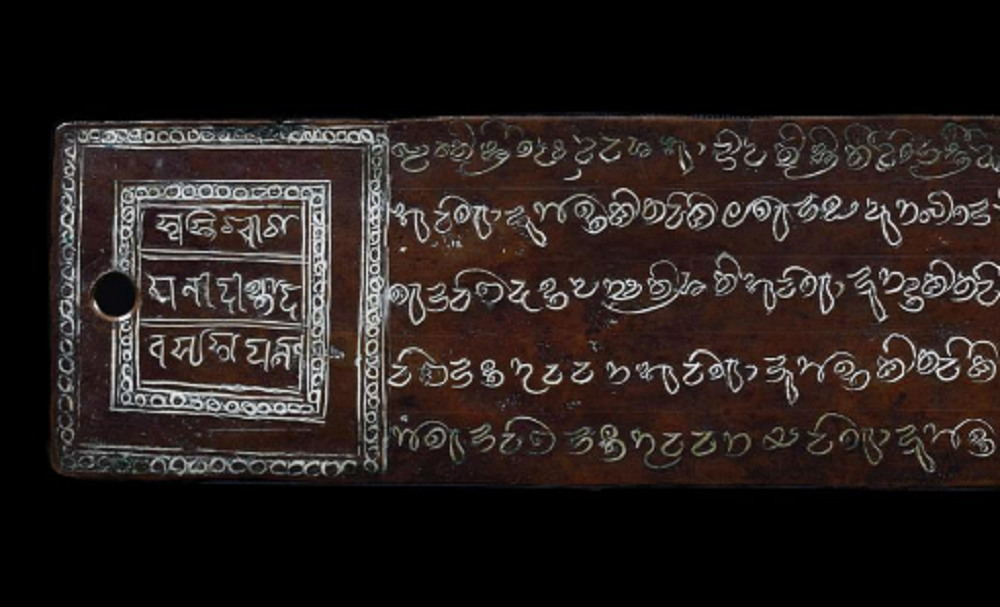
A lōmāfānu is a copperplate document: a series of long metal plates engraved with writing and held together by a ring. It is not a codex, not a scroll, and not a monumental inscription fixed to a building or stone surface. It is portable, but not casual; sequential, but not bound as a book; textual, but also legal, religious, political, and material in its authority.
The oldest preserved lōmāfānu date from the end of the twelfth century and were issued from Malé, the royal capital. Examples are known from Gan, Isdū, and Dambidū in Haddummati Atoll, a region that had contained important Buddhist monasteries before the conversion of the Maldives to Islam. These royal edicts did not merely record decisions; they gave political and religious commands a durable documentary form.
These objects not only preserve early Maldivian writing. Their importance lies in the kind of documentary act they perform. They record the reorganization of land, religion, authority, and institutional memory after conversion to Islam. They are not books of devotion, literature, or scholarship. They are instruments through which a new order was engraved into matter.
Copperplate Grants in an Island Kingdom
The lōmāfānu were copperplate grants in which royal decisions, donations, privileges, and endowments were inscribed on durable metal surfaces. In the Maldives, this documentary form took on a particular force because it was used at a moment of religious and political rupture.
The Isdū lōmāfānu is one of the clearest examples. It is a series of plates by which earlier grants to Buddhist monasteries were revoked and new grants for the construction and maintenance of mosques were issued. The event can be placed at the end of the twelfth century, during the radical transformation of Maldivian society after conversion to Islam.
This means that the lōmāfānu should not be treated as simple records of pious donations. They are acts of replacement. They belong to a documentary moment in which Buddhist institutional property, ritual space, and religious authority were being reassigned to mosque-centered structures. The copperplate does not merely preserve information about this transformation. It participates in making the transformation durable.
A grant engraved on copper does more than say that land or resources have been given. It stabilizes the act. It turns royal command into a physical object capable of being stored, guarded, displayed, consulted, and transmitted. It gives authority a material body.
The First Islamic Documentary Layer
The lōmāfānu are not the earliest written artefacts from the Maldives. The Landhoo inscription, a coral-stone object inscribed in a Brāhmī script similar to southern Indian varieties of about the sixth to eighth centuries, is the oldest autochthonous written artefact so far unearthed in the islands. Its text has been identified as a dhāraṇī spell, probably connected to a Buddhist monastery as a relic enshrined in a stupa.
The copperplates belong instead to the first preserved Islamic documentary layer. They appear after this older Buddhist and Indic written background, while still carrying parts of it in their graphic and linguistic form. Their main texts were written in early Dhivehi using the script often called evēla akuru, a term meaning something like "script of that time" or "script of old." This curly form of the old Maldivian alphabet shows affinities with South Indian script traditions, while Nāgarī or Proto-Bengali forms in some documents point to older Buddhist links with eastern Indian centers of learning.
The Isdū lōmāfānu makes this mixture especially visible. Issued by King Gaganāditya for Isdhoo in Haddummati, or Laamu Atoll, around 1194 CE, its main text is written in early Dhivehi and evēla akuru, while the royal seal uses a Nāgarī-type script and Sanskrit. The document is therefore Islamic in institutional function, but not graphically or linguistically detached from the earlier Indic world.
Conversion to Islam appears here as a redirection of inherited graphic resources toward a new religious and political order.
Language as Sediment
The lōmāfānu also preserve a layered linguistic field. Their texts bring together Dhivehi, Sanskrit, Arabic, Persian, and older Indic elements. The result is not a simple replacement of one religious vocabulary by another, but a written surface where several linguistic histories remain active at once.
In the Isdū lōmāfānu, Sanskrit elements appear not only in royal seals and signatures, but also in names, invocations, titles, and numbers written within the local script. Some Sanskrit endings are attached to Dhivehi word forms, showing that the older prestige language had not disappeared from documentary practice.
The same document also records the arrival of Islamic institutional vocabulary. Plate 13r includes forms such as masudid(h)u, from Arabic masjid, "mosque"; mālimu, from Arabic mu'allim, "teacher"; and mūdimu, from Arabic mu'aḏḏin, "muezzin." These terms were adapted into Dhivehi phonology and grammar and written in the local script.
The Gamu lōmāfānu adds Persian-derived religious vocabulary, including petāmbaru, from Persian pay(ġ)āmbar, "prophet"; roda, from Persian rōza, "fasting"; namādu, from Persian namāz, "prayer"; and miskitu, reflecting Early New Persian mazgit, "mosque." It also contains Islamic geographical and eschatological terms, including names of paradises and hells.
The copperplates therefore register conversion through language itself. Sanskrit formulas, Dhivehi administrative structures, Arabic institutional terms, Persian religious vocabulary, and local script practices coexist within the same documentary field. The authority of the new religious order was written through older linguistic materials rather than through a clean break from them.
Copperplates of Conversion
The surviving lōmāfānu should not be treated as interchangeable examples of "copper books." Each one preserves a specific documentary situation within the consolidation of Islam after the Buddhist period.
The Isdū lōmāfānu concerns the mosque of Isdū and the reallocation of resources to support the new institution. Its vocabulary is practical and administrative: reed for thatching, oil for lamps, alms rice, food shares for the Qur'an teacher and the muezzin, and allocations to the mosque. The document records conversion at the level of material provision. A new religious order required buildings, personnel, food, light, roofing, land, and recurring support.
The Gamu lōmāfānu, also issued in 1194, concerns a mosque on Gan, another island in Haddummati / Laamu Atoll. Its text moves from practical endowment into a broader Islamic cosmological frame, including lists of paradises and hells, Islamic geographical names, and a dense mixture of Arabic, Persian, Prakrit, Sanskrit, and Dhivehi elements. The document does not only fund a mosque. It situates the new institution within an imported religious universe, translated into local language and script.
The Dambidū lōmāfānu appears to operate on an even wider political scale. In that document, the royal edict addresses the islands from Kelā in the north to Aḍḍu in the south. Conversion is therefore not presented only as a local act of mosque foundation. It becomes an archipelagic command, distributed through royal documentary authority.
These records belong to a coercive moment of religious reorganization. The Maldives officially converted to Islam in the twelfth century, but the copperplates do not show a simple process of spiritual persuasion or gradual cultural drift. They are tied to royal order, institutional displacement, land reallocation, and the destruction or replacement of Buddhist religious spaces. Former monastic resources were redirected toward mosques. Earlier ritual landscapes were dismantled or overwritten. Craftsmen who had worked within Buddhist architectural and decorative traditions were redirected toward Islamic houses of prayer.
The Isdū and Gamu materials are especially stark in this regard. The former is associated with the revocation of grants to Buddhist monasteries and the creation of new grants for mosques. The latter records the breaking of stupa finials and the destruction of Vairocana statues. Other accounts connected with the same conversion process describe the violent treatment of monks from Haddummati monasteries.
The lōmāfānu should therefore not be softened into neutral records of "religious change." They are documents of administrative violence. They name what will be supported, what will be discontinued, which institutions will endure, and which ones will be displaced. Their authority lies precisely in this convergence of writing, metal, royal command, land, religion, and force.
The copperplate grant is not only a legal document. It is an instrument of reordered memory. It turns conversion into an administrative fact and gives that fact a durable material form.
Copper and the Lost Archive
The documentary power of the lōmāfānu becomes sharper when placed against what did not survive. Buddhist monks in the Maldives must have produced manuscripts, probably on screwpine leaves, but that organic manuscript culture left no surviving corpus. It was either burned, destroyed, or eliminated so thoroughly that it now survives only indirectly, through archaeological remains, later accounts, inscriptions, sculptures, and the documentary traces of the order that replaced it.
This creates an asymmetrical archive. Copper survives. Leaves do not. Royal edicts remain. Buddhist manuscripts vanish. The administrative voice of conversion is preserved, while much of the intellectual and ritual world it displaced has to be reconstructed from fragments. Much of the older Buddhist world has to be approached through partial, later, or materially displaced evidence.
The lōmāfānu are therefore not neutral survivors. Their durability belongs to a field of destruction. They preserve the new religious and political order in a material form strong enough to cross centuries, while the older organic archive disappeared almost completely. This does not prove that copper was chosen because of the island climate, but it does show how material difference shaped historical survival. Metal carried one kind of memory forward. Leaves did not.
The copperplates also record the remaking of religious space. Early Maldivian mosques preserved elements of older temple-building traditions: elaborate woodwork, painted ceilings, vegetal motifs, and sacred spatial arrangements redirected toward Islamic use. The Isdū lōmāfānu describes the construction of a mosque on the former monastery grounds of Śrī Isdū, including stone, timber, paintings, prayer direction, pulpit, thatch, walls, gateways, carved and lacquered ceiling structures, an alms-house, a store room, and other properties transferred to the mosque compound.
The continuity was not only stylistic. Craftsmen trained in earlier Buddhist architectural and decorative systems appear to have been redirected toward the construction of Islamic houses of prayer. Older skills survived, but their visual range narrowed under Islamic iconographic restrictions.
The document therefore records conversion as construction as well as command. It names land, materials, buildings, personnel, food, oil, thatch, walls, and compounds. It shows monastery grounds becoming mosque grounds, former properties being reassigned, and older craft systems being redirected under new religious conditions.
For book history, the crucial point is not only that one medium survived and another vanished, but that the surviving medium belongs to the order that reorganized the conditions of memory. The lōmāfānu is not only a record of belief. It is a record of spatial conversion. Its copper surface preserves the administrative remaking of territory, architecture, labor, and memory.
Durability Is Not Legibility
Copper gives the lōmāfānu unusual material force, but it does not make them self-explanatory. A plate may survive while the conditions that once made it readable disappear: scripts fall out of use, languages change, royal titles become obscure, and institutional references lose their immediate context. To read a lōmāfānu as more than engraved metal requires paleography, historical linguistics, epigraphy, religious history, and knowledge of Maldivian political institutions.
This uneven survival also appears in the built environment. Many older mosques in Malé were demolished, replaced, or altered during the twentieth century. Of the 33 mosques named by Bell in 1921, at least 15 had disappeared by the early 1980s. The copperplates could outlast the mosques they endowed, just as they outlasted much of the monastic world they helped replace.
The archive left behind is therefore partial. Metal remains. Buildings disappear. Manuscripts vanish. Script survives as specialist knowledge. A lōmāfānu can preserve a royal act across centuries, but it cannot preserve the full institutional, architectural, linguistic, and ritual life in which that act once operated.
For that reason, it should not be reduced to a "copper book." It is a bound sequence of metallic acts: royal command, mosque endowment, script transition, religious coercion, linguistic mixture, land reallocation, and institutional memory. Its plates, ring, engraved surface, and old script all participate in its authority.
The lōmāfānu is a political-religious act hardened into metal. It preserves the voice of the order that prevailed, while another textual world, organic, monastic, probably written on leaves, is now absent. It is a document of endurance and replacement at once: a durable record produced while older institutions, materials, and memories were being broken, reassigned, or made unreadable by destruction.
Bibliography
- Bell, H. C. P. (1930). Excerpta Maldiviana. No. 9: Lómáfánu. Journal of the Ceylon Branch of the Royal Asiatic Society, 31 (83), pp 539-578.
- Bell, H. C. P. (1940). The Maldive Islands: Monograph on the History, Archaeology and Epigraphy. Colombo: Ceylon Government Press.
- Gippert, Jost (2024). Written Artefacts from the Maldives: 1,500 Years of Mixing Languages and Scripts. In Sövegjártó, Szilvia and Vér, Márton (eds.) Exploring Multilingualism and Multiscriptism in Written Artefacts. Berlin: De Gruyter, pp. 13-40.
- Maniku, Hassan Ahmed, and Wijayawardhana, G. D. (1986). Isdhoo Loamaafaanu. Colombo: Royal Asiatic Society of Sri Lanka.
- Mohamed, Naseema (2005). Note on the Early History of the Maldives. Archipel, 70, pp. 7-14.
- Reynolds, C. H. B. (1984). The Mosques in the Maldive Islands: Further Notes. Archipel, 28, pp. 61-64.
- Romero-Frias, Xavier (1999). The Maldive Islanders: A Study of the Popular Culture of an Ancient Ocean Kingdom. Barcelona: Nova Ethnographia Indica.
- UNESCO Memory of the World Committee for Asia and the Pacific (2014). Loamaafaanu, Maldives: Nomination Form. https://www.mowcapunesco.org/register/loamaafaanu/