Home > Blog The Log of a Librarian > The Shape of Memory (01)
The Shape of Memory (01)
The Yam That Disappears
Ephemeral Documents and the Limits of the Book
This post is part of a series that explores the many ways human societies have stored, transmitted, and transformed memory across time, beyond the narrow histories centered on books and writing. It approaches archives, documents, and memory systems as historically situated technologies shaped by power, ecology, material conditions, and cultural worldviews, while examining forms of transmission often excluded from dominant narratives of literacy and preservation: oral traditions, woven patterns, musical structures, ritual performances, landscapes, bodies, and other living infrastructures of memory. Check all the posts in this section's index.
Beyond Durable Inscription
Histories of the book are commonly written as histories of increasingly stable containers for information. Clay tablets, papyrus rolls, codices, printed volumes, magnetic media, and digital storage systems are usually treated as successive variations of the same underlying principle: the preservation of information through material persistence. The document survives physically, and through that survival memory becomes transmissible across time.
This assumption is so deeply embedded within modern archival and bibliographic thought that systems operating according to different temporal logics are often excluded from the category of documentation altogether. Yet some societies have historically stabilized and transmitted socially significant information through processes that are cyclical, performative, embodied, and intentionally perishable.
One particularly revealing case emerges among the Abelam people living in the tropical rain forest of the Prince Alexander Mountains, in the East Sepik province of Papua New Guinea. Among them, ceremonial longg yams participate in systems of prestige, social memory, ritual continuity, and historical recognition. The point is not that "a yam is a book." Such analogies flatten both phenomena into metaphor. The more productive question concerns the conditions under which information becomes socially durable even when its material support is not.
Giant Yams and Ceremonial Visibility
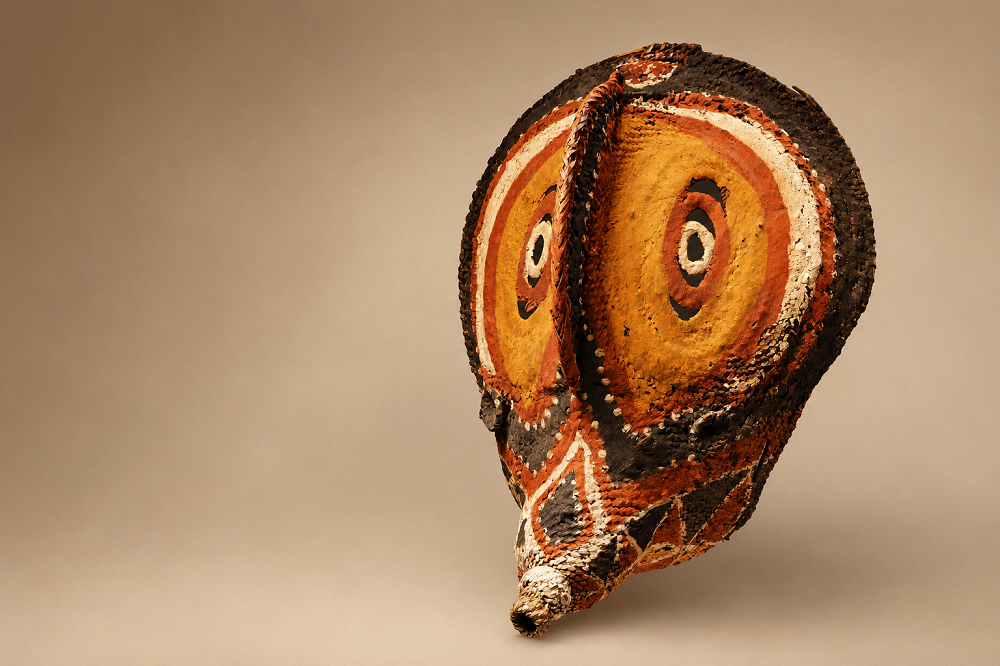
Among the Abelam, yam growing forms a large part of their life. But the cultivation of giant yams — as large as 80-90 inches — goes beyond the agricultural activity. Those long yams are produced within highly structured ceremonial systems involving specialized horticultural practices, ritual restrictions, competitive display, exchange relations, and elaborate forms of decoration. During ceremonial exhibitions, the yams may be transformed through complex basketry masks baba, pigments, shells, feathers, and vegetal ornamentation that convert them into publicly visible ceremonial objects. Their appearance reflects not only technical skill, but also prestige, inherited knowledge, ritual competence, and relations with spiritual forces associated with fertility and land.
Anthropological studies by researchers such as British anthropologist Anthony Forge have shown that these ceremonial systems cannot be reduced to subsistence production alone. Giant yams participate in broader structures of social recognition through which continuity, hierarchy, and memory are publicly enacted.
What matters here is that these processes transmit socially meaningful information without relying on stable inscription. The yam does not function as a textual surface upon which signs are fixed and preserved. Its significance emerges instead through ceremonial activation, public visibility, comparison with previous cycles, collective interpretation, and social memory. Histories of successful cultivation, prestige relations, ritual competence, and intergenerational continuity are not stored within an enduring object, but maintained through recurrent performative events.
Documentary Systems Without Permanence
From the perspective of conventional documentary theory, this creates a significant problem. The ceremonial system clearly operates as a mechanism for preserving and transmitting socially relevant knowledge, yet its material support is radically unstable. The yam decays. The decorations deteriorate. The ceremonial display disappears. Nothing equivalent to a permanent manuscript or archival record remains. Nevertheless, the social continuity associated with these events persists across generations.
This persistence depends not upon the indefinite survival of a fixed object, but upon repetition. Knowledge is maintained through seasonal reenactment, embodied expertise, oral transmission, ritual labor, and public recognition. The "record" survives because the event returns, not because the object endures.
The temporal logic underlying such systems differs profoundly from that of the codex or the archive. Written documents preserve information by resisting disappearance. The Abelam ceremonial yam system preserves continuity through cyclical regeneration despite disappearance. Decay is not external to the process of preservation, but one of its constitutive conditions.
The History of the Book Beyond the Book
The significance of this case extends beyond ethnographic curiosity. Modern documentary traditions have historically privileged durability, textuality, fixity, portability, and the separation of storage from performance. Systems dependent upon memory, ritual activation, embodied transmission, or seasonal recurrence have often been relegated to the domains of "culture" or "symbolism" rather than recognized as mechanisms for organizing and transmitting socially authoritative knowledge.
The Abelam case suggests a different possibility. Some documentary systems may not be designed around permanence at all. Their continuity depends precisely upon continual reactivation. Under such conditions, disappearance does not represent documentary failure. It becomes part of the mechanism through which preservation occurs.
Seen from this perspective, the history of the book becomes only one branch of a much broader history: the history of the material and social techniques through which human societies externalize, stabilize, reactivate, and legitimate memory.
Bibliography
- Buckland, Michael K. (1997). What Is a 'Document'? Journal of the American Society for Information Science, 48 (9), pp. 804-809.
- Briet, Suzanne (2006). What Is Documentation? Lanham, MD: Scarecrow Press.
- Day, Ronald E. (2001). The Modern Invention of Information: Discourse, History, and Power. Carbondale: Southern Illinois University Press.
- Forge, Anthony (1990). Art and Environment in the Sepik. Bathurst: Crawford House Press.
- Forge, Anthony (1973). The Abelam Artist. In Forge, A. (ed.) Primitive Art and Society. London: Oxford University Press, pp. 169-192.
- Scaglion, Richard (1979). The Codification of an Abelam Yam Cult. Ethnology, 18 (1), pp. 19-33.
- Scaglion, Richard (1999). My Men Are My Heroes: The Cult of the Long Yam in a New Guinea Society. Prospect Heights, IL: Waveland Press.